

A lot of teams buy a GEO dashboard and end up staring at a visibility score without a clear next move.
At Foundation, we evaluate these platforms for client work. Useful data should narrow the decision. A recurring citation can point us toward outreach. Weak coverage around a commercial topic can show us where the site is falling short.
Prompt volume has its place. So do visibility scores. Neither tells the team what to do on its own.
This guide looks at seven GEO tools through a practical lens. I’ll show where each one fits and what it costs. More importantly, I’ll look at whether the data gives your team a useful next move.
Key Takeaways
|
Why Marketers Use GEO Tools
Traditional SEO reports were built around rankings and clicks. GEO tools look at what happens inside the AI answer itself.
They help marketers see where a brand appears across ChatGPT, Google AI Overviews, Perplexity, and other answer engines. You can also see which sources are being cited, how competitors are showing up, and whether that visibility is changing over time.
That fills a reporting gap traditional analytics cannot cover well. A buyer can see your competitor recommended inside ChatGPT without ever creating a website visit for you to measure.
Foundation and AirOps tracked 5.1 million AI responses and 57.2 million citations across 50 B2B brands. Only 10.15% of those citations pointed to brand-owned domains. On unbranded discovery prompts, the share dropped to 2.2%.
I think of LLM SEO as the work and AI visibility as the outcome. GEO tools help teams measure that outcome and find the places where the work needs attention.
The Best GEO Tools at a Glance
A content team tracking a focused set of prompts needs a very different setup from an enterprise program covering several markets.
This table gives you a quick read on where each platform fits and what it costs.
| Tool | Best For | What Stands Out | Starting Price |
| Profound | Larger brands running a dedicated GEO program | FactCheck traces inaccurate AI claims back to the sources influencing them, alongside topic-level visibility and citation analysis | From $99/month, billed annually |
| Peec AI | SEO and content teams that want focused AI visibility tracking | Flexible prompt and model setup. Teams can choose three models, allocate prompts across projects, and adjust tracking as priorities change | From $95/month. Annual billing is about $80/month |
| Scrunch | Technical teams investigating AI crawler and agent behavior | Agent traffic monitoring, site audits, and AXP take the platform beyond prompt tracking into how AI systems actually interact with the site | From $250/month billed annually, or $300 month-to-month |
| SE Visible by SE Ranking | Teams that want GEO measurement close to an existing SEO workflow | Broad five-engine coverage at the entry tier, with 200 prompts and roughly 30,000 AI answers analyzed each month | From $99/month, or $79/month annually |
| Semrush AI Visibility Toolkit | Existing Semrush users adding AI search measurement | AI visibility sits beside Semrush’s SEO data and AI-readiness auditing, reducing the need for a separate research workflow | From $99/month per domain, billed annually |
| Ahrefs Brand Radar | SEO teams that want AI discovery data alongside Ahrefs | A massive prebuilt AI Visibility Index covering hundreds of millions of prompts, plus separate custom prompt tracking | AI Visibility Index from $199/month. Custom prompt tracking starts at $50/month |
| Goodie AI | Teams that want measurement tied more closely to execution and revenue | Closed-loop AEO workflow with optimization and revenue attribution, rather than stopping at visibility reporting | From $399/month for brands |
GEO tools compared by team fit, use case, and starting price. Pricing as of October 2026
The biggest difference is how much of the GEO workflow you want the platform to own. A team that mainly needs visibility tracking can keep the stack fairly lean. Once you add site auditing, source analysis, prompt research, and enterprise reporting, the options start separating quickly.
How I’d Choose a GEO Tool for Your Team
A five-person SEO team tracking 50 buying questions needs a lighter setup than a global brand monitoring thousands of prompts across markets.
I’d narrow the shortlist around the work the team actually has to do.
1. For Smaller SEO and Content Teams
Start with prompt coverage and citation data. You need enough visibility to see where the brand appears, which competitors keep showing up, and which sources are earning citations.
Peec and SE Visible are easier to justify here because the entry point is lower and the reporting covers the core monitoring work.
I’d spend more budget only when the team has a clear use for deeper analysis.
2. For Technical and AI Agent Work
Scrunch plays a different role. If your GEO work involves crawler access or JavaScript-heavy pages, prompt tracking leaves gaps. Scrunch adds site diagnostics and agent traffic data, which gives technical teams another place to investigate when visibility drops.
3. For Teams Already Working in Semrush or Ahrefs
Staying close to the SEO stack can save a lot of operational friction.
Semrush makes sense when AI visibility needs to sit beside keyword research, technical audits, and competitor analysis. Ahrefs Brand Radar is stronger for teams that already rely heavily on Ahrefs for backlinks, search research, and content discovery.
This is also where LLM SEO and traditional SEO start sharing more of the same workflow.
4. For Larger GEO Programs
Profound becomes more interesting once GEO has its own reporting cadence, owners, and budget.
Larger teams usually need broader prompt coverage, stronger competitor reporting, historical data, and enough depth to investigate why visibility moved. Those requirements push you toward platforms built specifically for ongoing AI visibility programs.
Goodie also belongs in the conversation when the team wants optimization work sitting closer to the monitoring layer.
4. For Technical and AI Agent Work
Goodie also belongs in the conversation when the team wants optimization work sitting closer to the monitoring layer.
Start with the first decision you expect the platform to help you make. If that decision is unclear, the tool is probably ahead of the strategy.
7 GEO Tools I’d Consider in 2026
1. Profound
Source: tryprofound.com
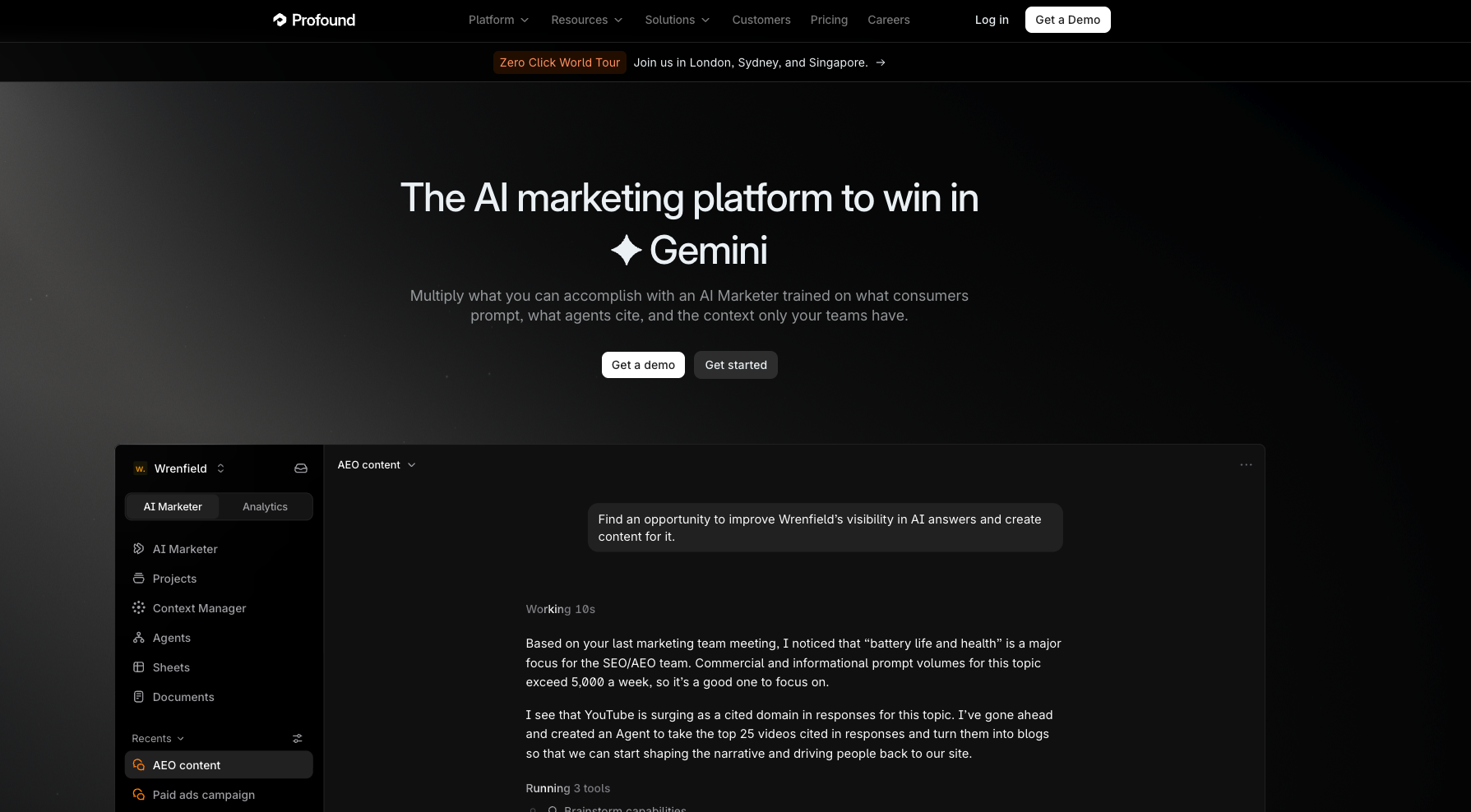
The most useful part of Profound is the citation data. When a client gains or loses visibility, we can see which pages and third-party sources are appearing in the answers, then compare that pattern against competitors.
I can group prompts around a product category, watch visibility and citation share over time, and see which domains keep influencing the answers. If one publisher repeatedly shows up around a topic where the client is weak, that can feed directly into outreach or distribution. If a competitor keeps earning citations from pages we are missing, that gives the content team a much clearer place to investigate.
For your own team, I’d use Profound around a defined set of commercial prompts rather than trying to track everything. Group them by product, audience, or buying problem, then review the citation patterns alongside your competitors.
The output should help you decide which pages deserve work and where third-party coverage could help.
Best for
Larger teams running GEO as an ongoing program rather than an occasional reporting exercise.
Pros
- Profound makes it easier to see which domains and pages are influencing AI answers, which is useful when you are trying to connect visibility back to content and distribution work.
- You can compare where competing brands are being mentioned and which sources keep helping them show up.
Cons
- Strong on monitoring, lighter on execution. Profound can show where visibility is moving and which sources are influencing answers, but the team still needs separate workflows for content changes, outreach, or technical fixes.
- Less useful for technical GEO diagnosis. If the issue sits with crawler access or how AI systems interact with the site, Profound gives you less depth than a tool built around that layer.
Pricing
Profound starts at $99/month billed annually for 50 prompts on ChatGPT. The Growth plan is $399/month and expands tracking to 100 prompts across ChatGPT, Perplexity, and Google AI Overviews. Larger programs can move into Enterprise for broader engine coverage and custom scale.
2. Peec AI

Source: Peec AI
Peec keeps the core GEO workflow fairly tight. You build a prompt set around the topics that matter to the business, choose the engines worth watching, and track how the brand performs across them.
Peec shows which domains and URLs keep getting cited for the prompts you care about, which gives you something more useful than a visibility score on its own. You can see where competitors are picking up coverage and which publishers seem to carry weight in the answers.
For work at Foundation, that help us decide where to investigate next. A recurring citation from G2, Reddit, or an industry publication points toward a very different play than a competitor’s own product page showing up repeatedly.
Peec also tracks visibility, position, sentiment, and share of voice by engine, with daily updates on its self-serve plans. That makes it useful when you already have an LLM SEO program running and need a clearer view of whether the work is changing what AI systems surface.
Best for
SEO and content teams that want focused prompt and citation tracking without a heavy enterprise setup.
Pros
- Easy to get focused quickly. You can build a prompt set around a category or product line and start tracking daily without configuring a huge reporting stack.
- Source tracking is genuinely useful. The citation view helps you see which third-party pages are shaping the answers around your market.
Cons
- The scope stays fairly focused. Peec is built around prompts, citations, competitors, and visibility rather than technical GEO or content optimization.
- Prompt limits can become restrictive. Teams covering several products or markets may outgrow the self-serve allowances quickly.
Pricing
Peec’s brand plans start at $95/month for Starter, which includes 50 prompts across three models. Pro costs $245/month for 150 prompts, while Advanced is $495/month for 350 prompts. Enterprise pricing is custom. Annual billing comes with a 15% discount.
3. Scrunch
Source: Scrunch
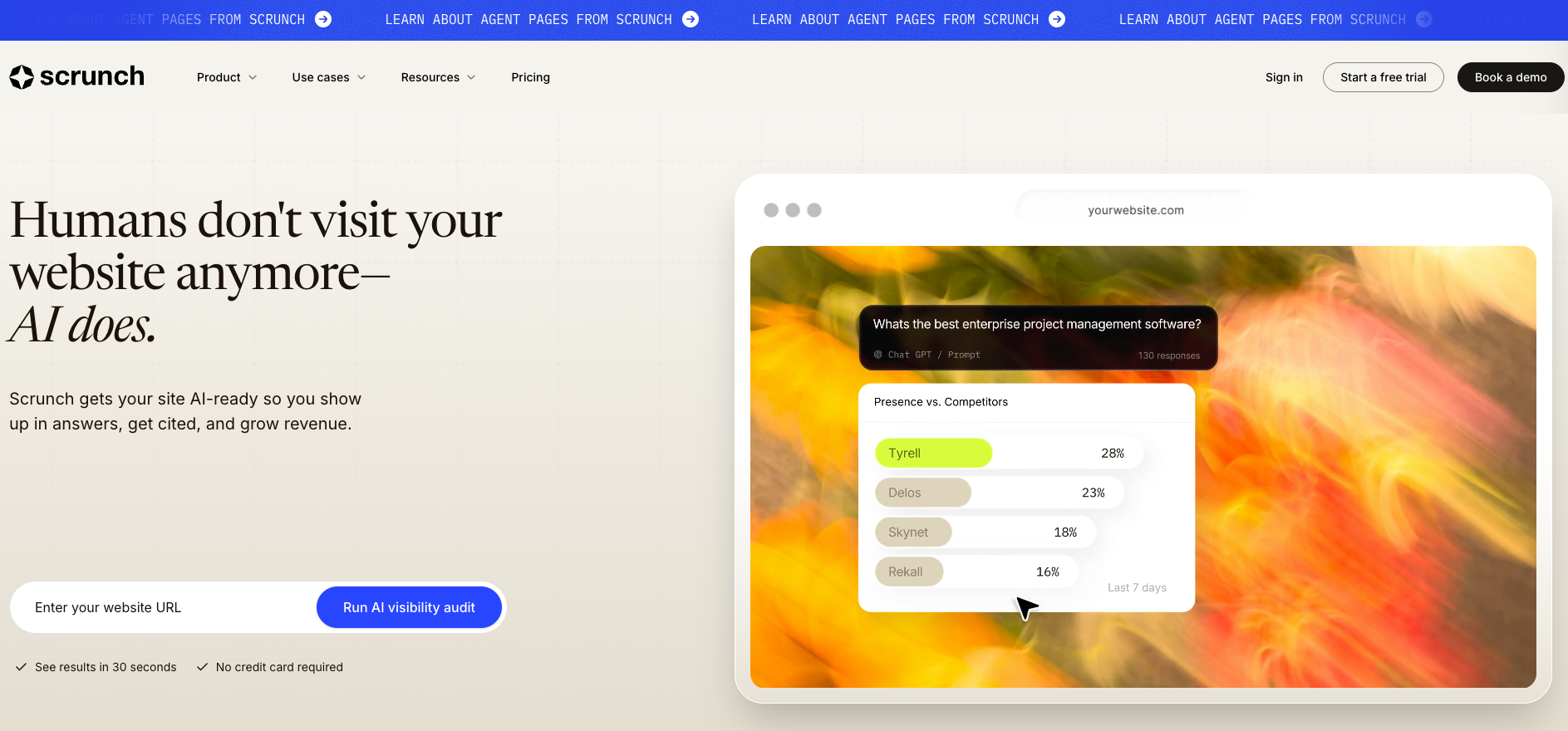
Scrunch goes further into site diagnostics and agent behavior than most GEO platforms. Alongside prompt tracking and citation monitoring, it shows how AI bots are accessing the site and where pages may be difficult for them to interpret.
If a page should be a strong source but rarely appears in AI answers, Scrunch gives you another place to investigate beyond the content itself.
Its citation reporting lets you see the domains and individual URLs being referenced across tracked prompts. I’d use that alongside its site diagnostics to work backwards from an AI answer.
That connects closely with answer engine optimization. Visibility depends partly on what you publish and partly on whether answer engines can retrieve and make sense of it.
Best for
Teams that want GEO monitoring plus a clearer view of how AI crawlers interact with their site.
Pros
- Strong technical layer. Agent traffic monitoring and site diagnostics add useful context when prompt data alone cannot explain a visibility problem.
- Detailed citation analysis. You can review cited domains and URLs down to the prompt level.
Cons
- The technical layer can be more than some teams need. If your main goal is prompt and citation tracking, the crawler and agent-focused tooling may add complexity.
- It asks for more technical involvement. Teams usually get more value from Scrunch when someone can investigate site diagnostics and agent behavior, not just read a visibility report.
Pricing
Scrunch Core costs $250 per month billed annually ($300 month-to-month) and includes 125 unique prompts, five site audits each month, one brand workspace, five users, and coverage across ChatGPT, Perplexity, Google AI Overviews, and Copilot. Enterprise pricing is custom and expands the model coverage, prompts, audits, integrations, and AXP access.
4. SE Visible by SE Ranking
Source: SE Visible
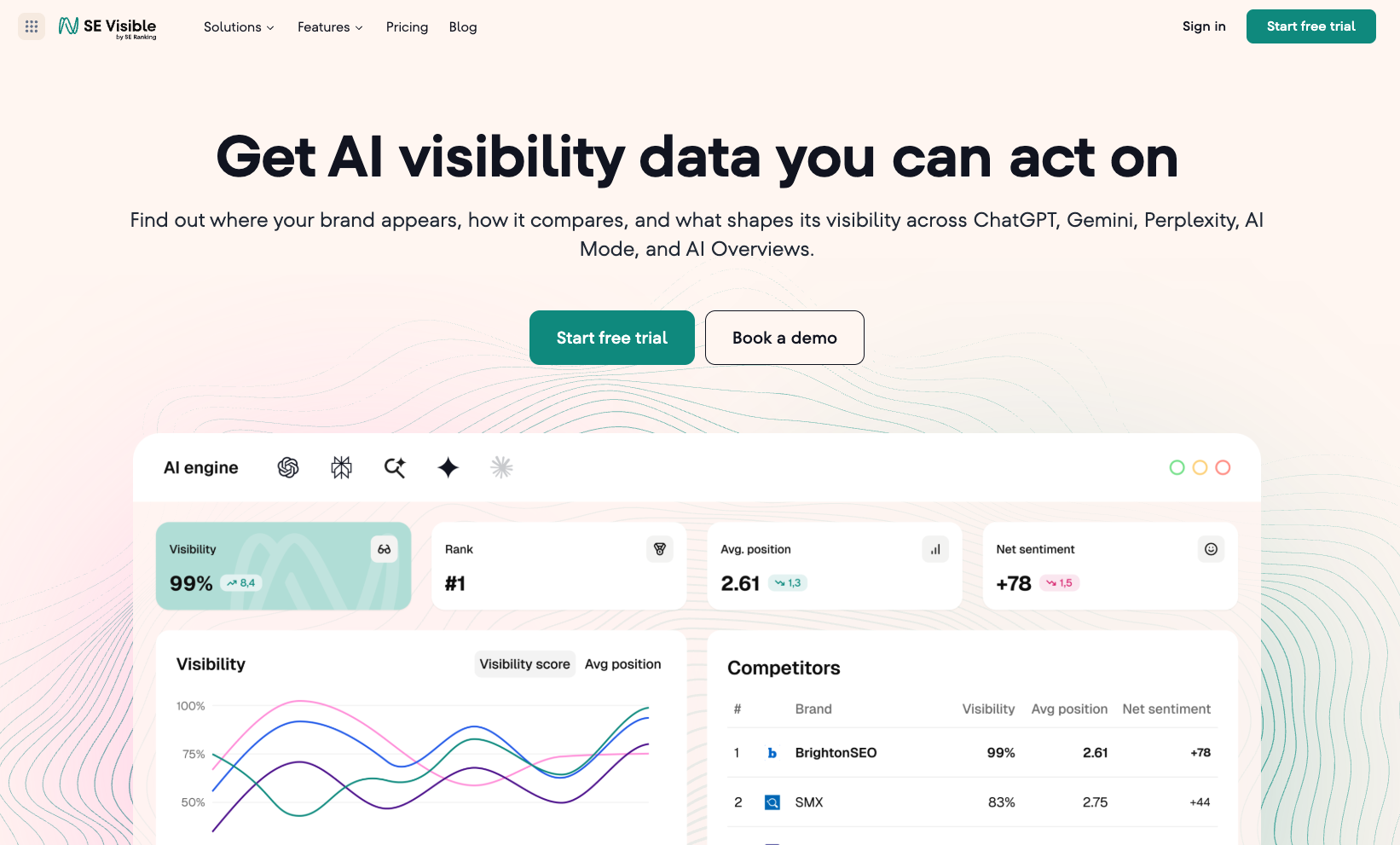
SE Visible tracks brand performance across ChatGPT, Gemini, Perplexity, Google AI Mode, and AI Overviews. Its dashboard covers visibility, share of voice, sentiment, prompts, and the sources cited inside the answers. You can open the underlying responses instead of relying on the score alone.
I’d use it around a defined product or category rather than dumping hundreds of prompts into the account on day one. Build a set around the questions buyers actually ask, add the competitors you care about, and watch what changes.
When a competitor starts appearing more often, I’d open those answers and look at the sources. A repeated citation from the same publication or competitor page tells me far more than a visibility score moving a few points. That source can become the starting point for content research, outreach, or a closer look at the client’s own page.
SE Visible also tracks brand position and sentiment alongside citations. For teams already doing AI visibility work, that adds another layer to the reporting without turning the exercise into a completely separate analytics project.
Best for
SEO teams adding AI visibility reporting to an established search workflow.
Pros
- You can inspect the evidence behind the metrics. Individual prompts open into the AI answers, brand mentions, citations, position, and sentiment.
- Coverage includes the major AI search surfaces. All current plans cover ChatGPT, Gemini, Perplexity, Google AI Mode, and AI Overviews.
Cons
- Prompt usage can disappear quickly. Each prompt and engine combination counts separately, so broad multi-engine tracking needs careful setup.
- White-label reporting is still missing. That can be limiting for agencies that need client-facing reporting under their own brand.
Pricing
SE Visible starts at $99 per month for 200 prompts and three projects. Core costs $189 per month for 450 prompts and five projects, while Plus costs $355 per month for 1,000 prompts and 10 projects. Annual billing reduces those rates by 20%, and there is a 10-day free trial.
5. Semrush AI Visibility Toolkit

Source: Semrush
Semrush makes the most sense to me when the team already works inside Semrush every week.
You’re not bringing in a separate GEO platform and building another reporting habit. AI visibility sits next to the search and technical data the team already knows how to use.
I’d look at Semrush when a client wants GEO measurement folded into an established SEO program. You can track the prompts you care about, inspect the citations behind the answers, and then move straight into the rest of the Semrush workflow when a page needs attention.
Foundation uses Profound as its AI visibility source of truth, so I wouldn’t position Semrush as a replacement for a dedicated GEO platform in our own workflow. Its advantage is convenience for teams already deep in Semrush.
Best for
SEO teams already using Semrush that want AI visibility tracking alongside their existing search workflow.
Pros
- Fits easily into an existing Semrush workflow. SEO and AI visibility data live in the same platform.
- Useful competitive data. You can review mentions, citations, prompt performance, and competitor visibility.
Cons
- The custom prompt allowance is fairly small. The base setup includes 25 tracked prompts, which can feel tight once you cover several categories or products.
- It works best inside the broader Semrush workflow. Teams looking for a dedicated GEO platform may find some of the value tied to the rest of the Semrush ecosystem.
Pricing
The AI Visibility Toolkit starts at $99 per month per domain when billed annually. The base plan includes 25 tracked prompts, competitor research, citation data, and AI-readiness auditing.
6. Ahrefs Brand Radar
 Source: Ahrefs
Ahrefs Brand Radar is strongest when you want to understand the market before deciding what deserves ongoing tracking.
We used Ahrefs Site Explorer and Brand Radar for Foundation’s Reddit Cloud 100 research. Across 71 B2B SaaS communities, the dataset surfaced 15,910 AI citations across seven assistants.
Six communities accounted for 73% of all citations. That kind of concentration is hard to spot from a small prompt list alone.
The large discovery index is the part I find most useful. You can search a category and see which brands and sources keep appearing before building a tighter monitoring set. Custom Prompts can then cover the questions you want to track regularly.
For teams already using Ahrefs for search and backlink research, Brand Radar fits naturally into the same research workflow.
Best for
SEO teams that want AI visibility data alongside the search and backlink research they already run in Ahrefs.
Pros
- Large discovery dataset. The AI Visibility Index covers hundreds of millions of prompts, so you can research a market before deciding what deserves ongoing tracking.
- Strong fit for existing Ahrefs users. Paid Ahrefs plans already include an allowance for custom AI prompt checks.
Cons
- Discovery and recurring tracking live in different parts of the product. The AI Visibility Index handles broad research, while Custom Prompts covers ongoing monitoring, so the workflow takes a little more understanding upfront.
- The dataset can be bigger than the decision you need to make. The large prompt index is useful for research, but teams still need to narrow the focus before turning it into a practical monitoring program.
Pricing
Custom prompt packages start at $50 per month for 2,500 checks. The AI Visibility Index starts at $199 per month for a single platform, while access across all supported platforms costs $699 per month and includes 2,500 custom prompt checks.
7. Goodie AI
Source: Goodie AI
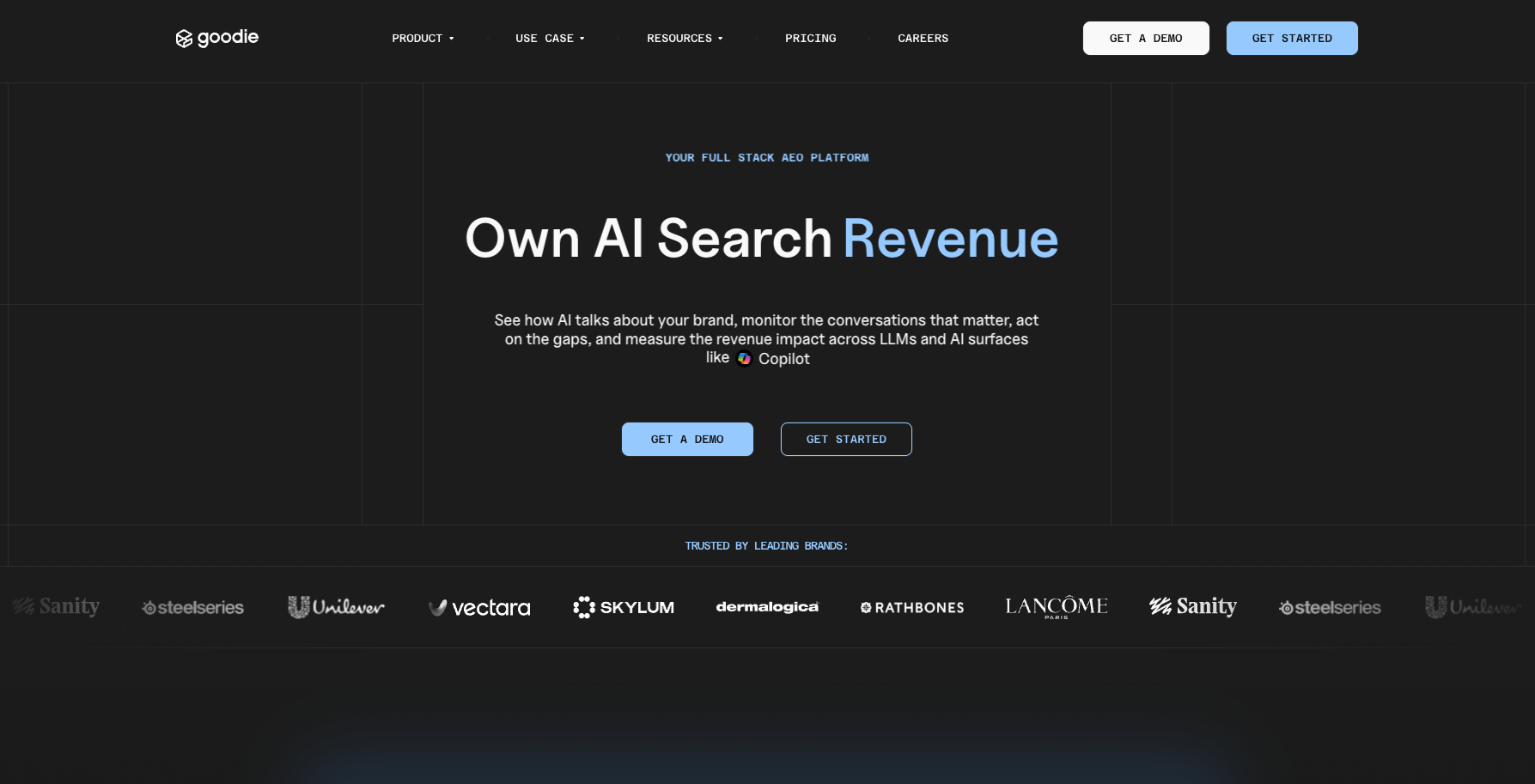
Goodie covers more of the workflow than a pure monitoring tool. It tracks brand mentions, citations, sentiment, and competitors across AI search, then adds prompt research, content optimization, technical recommendations, and outreach workflows.
The optimization layer is the main reason I’d look at it. A team can identify a visibility gap, trace the sources around it, and move into content or technical work without exporting the findings into another system.
Goodie also connects with Google Analytics and Search Console for teams trying to connect answer engine optimization work with traffic and conversions.
Best for
Teams that want AI visibility tracking and optimization work on the same platform.
Pros
- Covers research and execution. Prompt discovery, monitoring, content optimization, and technical actions sit in the same product.
- Strong attribution layer. Goodie connects AI referral traffic with conversions and revenue through Google Analytics integrations.
Cons
- It can be more workflow than a monitoring-only team needs. Goodie adds optimization, technical recommendations, and outreach on top of visibility tracking.
- Teams with established execution tools may duplicate work. If content optimization or outreach already lives elsewhere, part of Goodie’s broader workflow can overlap with systems already in place.
Pricing
Goodie’s Explorer plan costs $399 per month and includes 100 prompts, 3,000 AI responses per month, 10 optimization actions, and three seats. Pro and Enterprise use custom pricing.
Turn GEO Data Into a Real AI Visibility Program
GEO tools help by showing where your brand appears, which competitors get recommended, and which sources keep shaping the answer.
The hard part is deciding what to act on. A visibility gap might point to a page that needs stronger coverage.
It could expose a missing comparison page, weak third-party validation, poor representation on Reddit, or a technical problem affecting how AI systems access the site. The right response depends on what the data actually shows.
That is where Foundation’s work goes beyond the dashboard.
Our AI visibility programs combine prompt research, citation analysis, on-site content, technical GEO, Reddit, YouTube, and earned media around the surfaces that influence how buyers discover a brand.
Foundation also tracks performance over time so the strategy can change as the models and citation patterns change.
We’ve used this approach with Bitly, which now holds the #1 QR code visibility position in AI answers at 27.3%, ahead of Google, Canva, and Adobe.
If your GEO tool is showing you the gaps and your team needs a plan for closing them, Foundation’s AI Visibility team can help turn that data into an execution roadmap.
Build your AI visibility program with Foundation.
Frequently Asked Questions
1. How Many Prompts Should You Track in a GEO Tool?
The right number of prompts depends on the size of your GEO program. A smaller team can start with 25 to 50 prompts covering priority products, use cases, competitor comparisons, and buying questions. Larger brands may need hundreds or thousands of prompts across different markets and customer segments.
Quality matters more than volume. Each tracked prompt should represent a question your target audience is likely to ask an AI search engine.
2. How Do You Choose Prompts for GEO Tracking?
Start with prompts connected to commercial intent and brand discovery. These can include category searches, product comparisons, recommendation queries, use cases, and common customer problems.
Search Console data, customer interviews, sales conversations, Reddit discussions, and traditional keyword research can all help identify relevant questions. Review the prompt set periodically as customer language and AI search behavior change.
3. Should You Track Branded and Non-Branded Prompts Separately?
Yes. Branded prompts measure how AI platforms describe your company, products, and reputation when the user already knows the brand.
Non-branded prompts measure whether your company appears when someone asks for recommendations or researches a problem without mentioning you. Tracking both provides a clearer picture of existing brand perception and discovery opportunities.
4. How Often Should You Review GEO Data?
Weekly or monthly reviews are usually more useful than reacting to individual daily changes. AI-generated answers can vary between checks because models, sources, and search results continue to change.
Look for repeated movement across related prompts and citations. A consistent change over several reporting periods is more useful for decision-making than a single increase or decline.
5. Can You Compare GEO Visibility Scores Between Different Tools?
GEO visibility scores should generally be compared within the same platform. Each tool can use its own prompt database, AI engines, sampling process, and visibility calculation.
If you switch platforms, establish a new baseline rather than treating the new score as a direct continuation of the previous tool’s data.