

Updated October 24, 2026. I added citation data by AI engine, the page types that earn citations, a schema correction, a 30-day starter plan and a short glossary. The rest is the original guide.
By Ross Simmonds, founder and CEO of Foundation Marketing and author of Create Once, Distribute Forever. Foundation is a certified Profound, Reddit and AirOps partner. Last updated October 24, 2026.
Answer Engine Optimization is the marketing process for creating and optimizing content in a way that influences answer engines such as Claude, Gemini, ChatGPT and more. It’s a marketing practice that can be done in-house or with an agency.
I’ve spent over a decade helping B2B brands get found in search. And I’ll tell you something most SEOs don’t want to hear…
The click is dying.
People aren’t asking Google for ten blue links anymore. They’re asking ChatGPT, Perplexity, and Google’s AI Overviews for one answer. And those engines don’t reward the same things Google rewarded in 2019.
Here’s the stat that changed how I think about this: only about 12% of the URLs ChatGPT cites also rank in Google’s top 10 for the same query. Read that again. Nearly 9 out of 10 citations go to pages that traditional SEO says shouldn’t win.
That gap is the opportunity. And Answer Engine Optimization is how you capture it.
Smart marketing strategies go beyond traditional search engine result pages.
In this guide, we’ll explore what AEO is, why it’s crucial, and how you can implement strategies to ensure your content thrives in AI-powered answer engine environments.
What Is Answer Engine Optimization?
Answer Engine Optimization (AEO) is the strategic process of creating and structuring content to ensure it is optimized for AI-driven systems, such as voice assistants, chatbots, and search engines, that deliver direct answers to user queries rather than providing a list of links. AEO focuses on making content easily digestible and actionable for these systems by using concise, structured, and highly relevant information, enabling improved discoverability, usability, and user satisfaction in an answer-first digital environment.
Unlike SEO, which focuses on ranking content in traditional search results, AEO focuses on making content easily consumable and accessible by AI systems.
These AI systems are designed to provide concise, actionable answers by processing vast amounts of information and presenting the most relevant data.
When you optimize content for AEO, you’re not just aiming for visibility in search engines but ensuring that your content is selected, processed, and displayed as part of an answer in AI-driven systems. Think of it as making sure your content is part of the conversation…
Responding directly to user questions.
For example, when a user asks a question like, “What are the benefits of electric vehicles?” AI engines like Google’s Gemini, Claude or Perplexity will generate an answer directly based on information pulled from trusted sources. If your content is optimized for AEO, it may be selected by these engines as a source to answer that question.
AEO ensures that your content isn’t just found, but that it is directly incorporated into these conversational, AI-driven responses.
The Difference Between SEO & AEO
Simply put, SEO focuses on ranking high in traditional search results, and AEO is about getting your content featured in direct, AI-generated answers. The core difference lies in the goals and how the content is consumed.
- SEO aims to rank content high in search results, where users typically click through to visit a webpage. SEO strategies include keyword research, content creation, link building, and technical optimizations to improve a site’s visibility in traditional SERPs.
- AEO, on the other hand, focuses on creating content that answers specific user queries in a way that is optimized for AI engines to pull and present without requiring a user to click through to your website. AEO is all about crafting direct answers that AI systems can quickly process and present to the user.
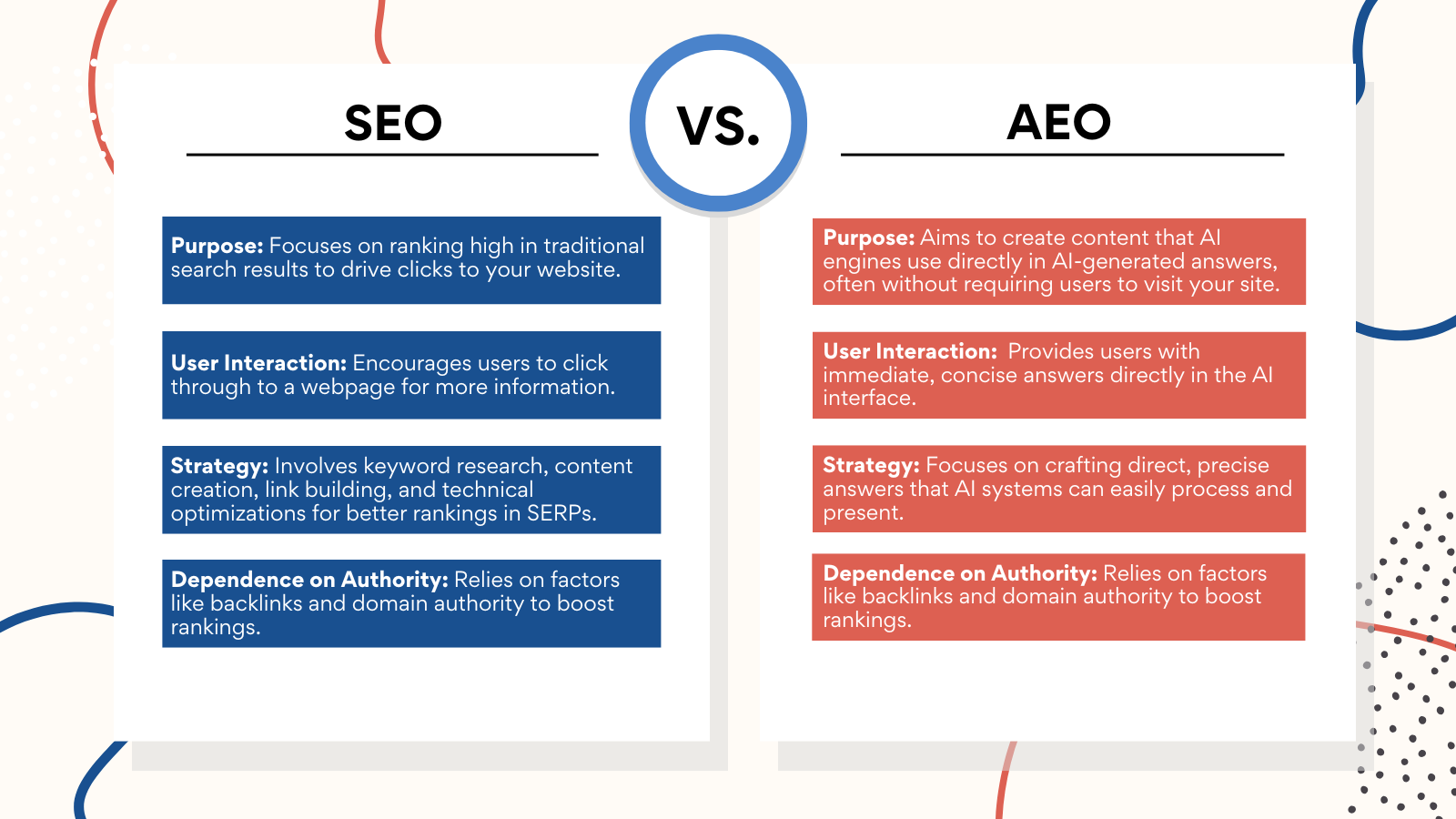
Key Differences:
- SEO drives clicks through search results and focuses on ranking high for specific keywords, while AEO optimizes content to be used directly in AI-generated answers.
- SEO depends on page rankings and authority (backlinks, etc.), while AEO is about ensuring that content directly addresses questions in a clear, concise manner that AI engines can interpret.
Here are a few other things to note:
Competition In SEO vs AEO
SEO competes for a ranking position on a results page. AEO competes for a citation inside a generated answer.
Clicking vs Digesting In SEO vs AEO
SEO assumes a click happens. AEO assumes it might not. Your brand can win the moment even when the visit never comes, so brand presence inside the answer matters as much as the link.
The SEO Algorithm vs. LLM Algorithm
Google’s top 10 leans on domain authority and backlinks. Answer engines pull heavily from Reddit threads, community discussions, comparison content, and pages that answer a question cleanly in the first 100 words. That’s why the overlap between rankings and citations is so low.
The Citation Surfaces For LLM Visibility
SEO happens on your website. AEO happens everywhere the models learn from: your site, review platforms, YouTube, Reddit, podcasts, third-party publications. Your website is one input among many.
The Advent of AEO and Why It’s Necessary
Why is AEO becoming so important? The shift to AI-driven engines has been accelerated by the increasing reliance on tools like ChatGPT, Google’s Gemini, and even voice assistants like Siri and Alexa.
More and more, people want answers fast. And they don’t want to have to sift through multiple search results to get them.
AI-driven tools, which are capable of understanding natural language and generating contextual responses, are now integrated into daily information searches. This shift is pushing marketers to rethink how they approach search.
When a user asks a question, their expectation is to receive an immediate, accurate answer rather than a list of links to click on.
As more users turn to generative AI for answers, marketers who adapt by optimizing for AEO will ensure that their content is visible when AI tools provide those answers.
Therefore, to enhance the visibility of your content in AI-driven search results, it’s essential to provide direct answers to common questions in your field and support your content with citations from reputable sources.
This helps you meet user expectations but also aligns with the content prioritization mechanisms of AI search engines.
What The Data Says About Clicks And Citations
Opinions about AEO are cheap. Here is what the measurements show.
Pew Research Center studied the browsing of 900 US adults in March 2025. The sample covered 68,879 unique Google searches, and about 18% of them produced an AI summary.
| Behavior | With an AI summary | Without one |
|---|---|---|
| Clicked a traditional result link | 8% of visits | 15% of visits |
| Clicked a link inside the AI summary | 1% of visits | Not applicable |
| Ended the browsing session after the page | 26% of pages | 16% of pages |
That study covers Google in one month of 2025. It is a snapshot. The direction is clear. When the answer sits above the links, fewer people go past it. So the answer is where your brand has to appear.
Google is direct about how to get there. Its documentation says there are no additional requirements to appear in AI Overviews or AI Mode, and no special optimizations are necessary. A page has to be indexed and eligible to show a snippet. There is no special schema to add, and any structured data you use has to match the visible text.
Our own data adds the part Google does not spell out. At Foundation we track how six AI surfaces cite sources across B2B software categories. Our main dataset covers about 380,000 answers collected between June 22 and July 24, 2026. Three findings matter most for AEO.
- Sources differ by engine. ChatGPT, Google, Claude and Perplexity lean on different parts of the internet. I walk through the split in how Google, Claude and Perplexity differ.
- Review sites carry real weight. G2 was the second most-cited domain in our data, and it overtook Reddit on ChatGPT in August. The detail is in my G2 breakdown.
- Source mix moves fast. ChatGPT cut its Reddit citations by more than half between July and August 2026, as I show in the Reddit citations post. A plan built on one platform can break in a month.
The full numbers live on my AI visibility statistics page. To see which engine matters for your category, use the AI visibility by category lookup.
AEO By Engine: The Citation Mix Is Not The Same Everywhere
One playbook does not fit every answer engine. In the State of B2B AI Discovery study I ran with AirOps, we logged about 380,000 AI answers to B2B software prompts across six surfaces between June 22 and July 24, 2026. Here is how citations split by source type on each one.
| Source type | ChatGPT | Gemini | Perplexity | Google AI Mode | Google AI Overview | Claude |
|---|---|---|---|---|---|---|
| Products | 55.55% | 71.63% | 51.74% | 60.42% | 61.54% | 60.58% |
| Reviews | 15.90% | 11.02% | 19.96% | 8.83% | 9.49% | 20.99% |
| Communities | 9.26% | 5.27% | 6.88% | 9.57% | 8.47% | 2.67% |
| Social | 0.26% | 0.28% | 2.28% | 6.91% | 6.95% | 0.15% |
Four things stand out.
- Product and brand pages win on every surface. Your own comparison, use-case and pricing pages do more citation work than most blog content.
- Claude leans hardest on review sites, with a 20.99% share. If Claude matters to your buyers, your G2 and Capterra profiles are owned media.
- ChatGPT gives 9.26% of its citations to communities, almost all Reddit. That mix shifted fast, as I covered in how ChatGPT cut its Reddit citations roughly in half.
- Google’s AI Overview and AI Mode send about 7% of citations to social domains like YouTube and LinkedIn. The standalone assistants send 0.3% or less. Video earns its keep mostly on Google.
The full dataset and the outside research I trust sit on my AI visibility statistics page.
The Page Types To Build First
Among the 100 most-cited URLs in that dataset, 59 were comparison pages and 25 were listicles. Together they drew 66,232 citation events. AI engines reward pages that help a buyer choose.
- Comparison pages. Your product against each named competitor, with a table and a plain verdict.
- Alternatives pages. The page a buyer reads when they are leaving someone else.
- Use-case pages. One page per job your product does, written around the question a buyer would type.
- Pricing and integration pages. Clear numbers and named tools give a model something to quote.
- Original research. The only page that can answer a question nobody else has measured. My research-driven content guide shows how to build it.
How AEO Works: Key Components and Strategies
Answer engines run a version of the same loop every time:
Step 1: They interpret the question
Natural language processing breaks the query into intent and context. “Best AEO tools” and “what is AEO” trigger completely different retrieval.
Step 2: They retrieve candidate sources
The engine pulls from its training data plus live retrieval (search indexes, licensed content, community platforms). This is where most brands lose… they simply never make the candidate pool.
Step 3: They select what to cite
Clear structure, direct answers, verifiable claims, and corroboration across multiple sources all raise your odds. If five independent places on the internet agree you’re a leader in your category, the model believes it.
Step 4: They generate the answer
Your content gets synthesized, often paraphrased, sometimes cited by name. The brands mentioned at this stage own the moment of decision.
Your job is to engineer steps 2 and 3.
To optimize your content for AEO, you need to understand the key components that AI-driven engines look for when selecting content.
How to Do AEO: A 6-Step Framework From Foundation
Here’s the process we run at Foundation for clients across B2B SaaS, fintech, and enterprise.
1. Mine the questions
Start with what people actually ask. Pull the People Also Ask boxes for your category. Scrape Reddit and community forums. Run your keyword research through a question lens. Then go one layer deeper and prompt the AI engines themselves… ask ChatGPT and Perplexity the questions your buyers ask and study whose content shows up.
2. Lead with the answer
Every page targeting a question should answer it in the first two to three sentences. Definition first. Nuance second. Story third. The 40-word direct answer at the top of this article exists for exactly this reason. Machines extract it. Humans appreciate it.
3. Structure for extraction
Use question-based H2s. Keep paragraphs short. Use numbered lists for processes and comparisons. Add FAQ, HowTo, and Article schema so engines can parse context without guessing. None of this is exotic. It’s discipline.
4. Earn citations, don’t just claim authority
Answer engines cross-reference. A claim on your blog carries weight when third parties back it up. That means original research, real data, expert quotes, and being present in the places engines actually pull from… Reddit, review sites, industry publications, YouTube. This is where distribution stops being a nice-to-have and becomes the strategy.
5. Distribute across every surface
One asset should become fifteen. A research report becomes a LinkedIn series, a YouTube breakdown, a podcast conversation, a Reddit AMA, a guest column. Every additional surface is another chance for a model to encounter your brand and another vote of corroboration when it decides who to cite.
6. Measure and adapt
Track your citations, not just your rankings. Tools like Profound, Ahrefs’ Brand Radar, and AirOps will show you when and where the engines mention you. Watch which prompts surface competitors instead of you, close those gaps, and re-run the loop monthly. This space moves fast. Your measurement has to move with it.
5 Key Factors for AEO Success
To ensure your content is optimized for AEO, here are some key factors to keep in mind:
1. Clear, Concise, and Direct Answers:
When users turn to search engines or AI assistants, they want quick and reliable answers. Provide information that directly addresses their questions with clarity and precision.
Structure your content using bullet points, short paragraphs, and headings to make it easy to navigate. Avoid lengthy introductions or unnecessary jargon and get straight to the point.
For example, if a user asks, “What is the best way to optimize my website for AEO?” your response should be concise, such as:
- Use schema markup to highlight key content.
- Improve site speed and mobile responsiveness.
- Create high-quality, question-driven content.
This type of structured format ensures AI engines can extract and deliver your answers effectively.
2. Citations and References:
Credibility matters, not just to readers but also to AI systems. AI engines prioritize content that includes authoritative citations and references. If your content mentions scientific studies, industry reports, or expert opinions, ensure you link to reputable sources.
For example, instead of making a general claim like “AEO can boost website traffic,” back it up with a stat or study, such as: “According to a recent study by XYZ, implementing AEO strategies increased organic traffic by 30%.” This demonstrates authority and makes your content more appealing to AI-driven platforms.
3. Rich Media:
Text-based content is essential, but incorporating rich media elements can make your answers even more engaging. Infographics can simplify complex data, videos can provide in-depth explanations, and diagrams can visually break down processes.
For example, if you’re explaining “How to optimize for AEO,” a video walkthrough or a flowchart showing the steps can make the content easier to understand and more shareable. Rich media not only boosts engagement for human readers but also signals relevance and quality to AI engines.
4. Multichannel Distribution:
Don’t limit your content to just one platform. Sharing it across forums, social media, podcasts, and other distribution channels increases its visibility and authority.
For example, a well-researched blog post can be repurposed into a LinkedIn article, a podcast discussion, or even a YouTube video. The more your content is cited or linked back to, the more trustworthy it appears to AI engines.
Additionally, engaging with your audience on multiple platforms helps you stay attuned to their needs, allowing you to create even more targeted content.
5. Technical Optimization:
Behind the scenes, your website’s technical foundation plays a significant role in AEO success. Ensure that your pages load quickly, as slow load times can result in higher bounce rates and lower rankings.
Optimize for mobile-friendliness, as mobile users now make up a significant portion of search traffic. Finally, use schema markup to help AI engines identify your content’s context.
For example, if you have an FAQ section, use FAQ schema to make it easier for AI to extract and present your answers directly to users. These technical improvements ensure your content is both accessible and favored by AI systems.
A Step-by-Step Approach to Implementing AEO
Now that you understand the core principles of AEO, here’s a step-by-step guide to help you implement AEO strategies:
1. Identify Common Questions:
Use keyword research tools and user-generated content (such as forums or social media) to identify the questions your audience is asking. Look for frequently searched terms or common pain points in your industry.
2. Create Answer-Focused Content:
Develop content that directly answers those questions. Provide clear, detailed, and actionable answers that offer real value to the user. Focus on quality, not quantity—one well-answered question is more effective than multiple vague answers.
3. Incorporate Citations and Data:
Bolster your content’s credibility by using reputable sources, statistics, and expert quotes. This not only helps with SEO but also increases the likelihood that your content will be selected by AI engines.
4. Optimize for Structured Data:
Implement schema markup on your content to help AI engines identify and understand your data more effectively. Use structured formats like FAQs, How-Tos, and Reviews to make it easier for AI engines to process your content.
5. Monitor and Adapt:
Continuously monitor how your content is performing in AI-driven search results. Use analytics tools to track whether your content is being selected for AI answers. As AI systems evolve, adapt your strategy to ensure continued success.
A 30-Day AEO Starter Plan
If you are starting from zero, run this before you buy a single tool.
- Week 1: Collect 50 real buyer questions from sales calls, support tickets and Reddit threads. Run them in ChatGPT, Perplexity, Gemini and Claude. Log who gets named and who gets cited.
- Week 2: Check access. Make sure the search crawlers from OpenAI, Anthropic and Perplexity are allowed in robots.txt and not blocked at the CDN. My LLM SEO guide walks through it.
- Week 3: Rewrite your five most important commercial pages so each section opens with a direct answer. Add dates, numbers and named sources.
- Week 4: Pick the two off-site surfaces where your category gets cited. Review sites, Reddit or YouTube, depending on the engine data above. Ship one asset on each.
Then re-run the same 50 questions and compare. That is your baseline and your first win in one document.
AEO Runs On Distribution
Engines build confidence from agreement across sources. One page on your site is one vote. A research report that turns into a LinkedIn series, a YouTube breakdown, a podcast conversation and a Reddit thread is five more. That is why I treat AEO as a distribution problem first. The same asset has to travel. Start with my content distribution guide and my breakdown of how distribution opens the gates to LLM citations.
How To Report AEO Without Overselling It
Leadership will ask for a number. Give them four honest ones.
- Share of AI recommendation. Of your tracked buyer questions, the percentage of answers that name you. Report the trend and say the prompt set is a sample.
- AI referral traffic. Segment chatgpt.com, perplexity.ai and gemini.google.com in analytics. The volume is small and the visitors often convert well.
- Crawler activity. Your server logs show whether GPTBot, ClaudeBot and PerplexityBot are reaching the pages you care about.
- Self-reported attribution. Add “an AI assistant” to the how-did-you-hear-about-us field and read the sales notes.
Tools can automate the first one. I compare the options in my review of AirOps and in my upcoming comparison of the best AEO platforms.
AEO, GEO And LLM SEO: Quick Glossary
| Term | What it means | Where to read more |
|---|---|---|
| AEO | Structuring content so answer engines can lift and cite it | This guide |
| GEO | Optimizing for generative engines; the term comes from a 2023 research paper | Aggarwal et al., GEO paper |
| LLM SEO | Making your brand legible to the language models themselves, across training and retrieval | My LLM SEO guide |
Common AEO Mistakes
- Treating AEO as a rebrand of SEO and changing nothing.
- Optimizing for one engine and ignoring the rest.
- Publishing thin pages with no data and no named sources.
- Ignoring review sites, communities and video.
- Measuring clicks only. Many AI-driven buyers never click.
- Chasing tricks like special files or markup that Google says it does not need.
How Long Does AEO Take?
Expect months, not weeks. Technical fixes can show up fast. Third-party proof takes longer, because it depends on other people. I tell teams to commit to a quarter of steady work before they judge the result.
Update: Google changed the rules on two of those types. In August 2023 it limited FAQ rich results to well-known government and health sites and removed HowTo rich results. Keep structured data that matches what readers can see on the page, but do not expect FAQ markup to win a rich result. Google also says AI Overviews and AI Mode need no special schema or AI-specific files.
Frequently Asked Questions About AEO
What is AEO in simple terms?
AEO is the practice of making your content easy for AI tools to cite, so your brand appears inside the answers buyers read.
Is AEO different from SEO?
Yes, though they overlap. SEO aims to rank pages and earn clicks. AEO aims to get cited inside the answer. Strong SEO still helps, since AI Overviews and AI Mode build on Google Search.
Is AEO the same as GEO?
Mostly. GEO is the research-led label and AEO is the practitioner label. I explain the origin in my guide to generative engine optimization.
Do I need special schema markup for AEO?
Google says no. It states that no special schema or new files are required to appear in AI Overviews or AI Mode. Use structured data when it accurately matches your page.
Which AI engines should I focus on?
It depends on your category. The 81-category lookup shows which engine each B2B category should care about most.
How do I measure AEO?
Pick a fixed set of buyer prompts. Run them across the main engines each month. Record how often your brand is named, cited or recommended, and compare it with competitors. Foundation covers tooling in its guide to AI citation tracking.
Sources And Method
Foundation’s citation data comes from about 380,000 B2B answers across six AI surfaces, collected June 22 to July 24, 2026, in the US. Outside research: Google Search Central, AI features and your website and Pew Research Center, July 2025.
Ready to Succeed in the Age of Answer Engines? Embrace the Shift
The rise of AI-driven answer engines represents a transformative shift in the digital landscape. To stay ahead, it’s no longer enough to focus solely on traditional SEO. Marketers and content creators need to adapt by optimizing their strategies for these next-gen systems, ensuring their content is not just visible but selected as part of AI-generated answers.
The organizations thriving today are those embracing innovation and reshaping their approach to align with how people consume content in this new era. Whether it’s through crafting direct answers, leveraging structured data, or distributing content across multiple channels, success in AEO comes down to meeting users where they are—and delivering the answers they need.