

Matt Paulson was 22 years old, doing graphic design for a living, and running a finance newsletter on the side that made him $50–75K a year.
He thought he was hot stuff.
Between his day job and the side hustle, he was pulling in around $150K — way ahead of his classmates, all of whom had just taken regular jobs. He bought a house. Paid it off in a year. Carried zero student debt.
He had no idea there were more levels.
That little side project? It’s now MarketBeat — a financial media platform on track to hit $60–65 million in revenue this year, run by a team of fewer than 20 full-time employees, headquartered in Sioux Falls, South Dakota.
No venture capital. No Silicon Valley network. No flashy rebrand or growth hack that changed everything overnight.
Just a guy from a small town who figured out something most marketers still haven’t:
Distribution is the moat. Not content.
I had Matt on the podcast recently and came away with pages of notes. This is me sharing everything.
Grab a coffee. Bookmark this one. Let’s dive in.
It started with a lesson that wiped out half his traffic
Back in the early Web 2.0 blogging days, Matt noticed something that made him deeply uncomfortable.
Average blogs with strong distribution were consistently outperforming great blogs with weak distribution.
Not occasionally. Every time.
The quality of the content barely mattered if nobody was reading it. Distribution was the variable that explained everything.
Then Google rolled out Panda and Penguin. Overnight, half his traffic was gone.
And that lesson — the one he’d already started to suspect — got burned in permanently.
His response wasn’t to write better content. It was to look for distribution channels everyone else was ignoring.
He found them across the top of Google — the tabs most marketers walked right past. Images. News. Video. Finance.
He went all in on the Finance tab.
At his peak, MarketBeat owned 30% of Google Finance news results across 20 different websites.
Thirty percent.
While everyone was scrapping over the same blue-link keyword rankings, he was dominating the tabs nobody else was competing on. Google was sending 200,000 page views a day to his properties.
And the whole time, he was capturing emails. Lightbox popup. Simple offer: “You’re reading about Tesla stock — want more stories like this delivered to your inbox?”
That was the play. Find underpriced distribution. Own it. Then convert the traffic into something you actually own: an email list.
This is something I’ve said a thousand times and I’ll keep saying it: the work happens after you press publish.
Most people celebrate hitting publish. Pop the bubbly. Life is good.
But in reality? You’ve just finished the first 10% of the job. The distribution, the amplification, the channel strategy — that’s where the real leverage lives.
MarketBeat is proof.
The moment Matt Paulson almost walked away
Here’s the part of Matt’s story that most people don’t know.
In 2016, he came within a deal of selling the whole thing.
His first kid was born 10 weeks premature. His second came 6 weeks early. His wife was dealing with pre and postpartum complications. Life was hard in ways that revenue numbers can’t capture. He listed MarketBeat with a broker….
He told them: get me $8 million and I’ll sell.
At the time, the business was doing $2 million a year in revenue.
The offer never came…
So he kept going.
I’m not going to editorialize this too much because I don’t think it needs it. But I’ll say this: every founder I know has a version of this moment. The moment where quitting feels like the rational choice.
Matt didn’t quit. Not because he was fearless. Because the deal didn’t close.
Sometimes the long game just means staying in the game long enough for your circumstances to change.
Today that $2M business is worth a lot more than $8M. It does over $50M a year…
Email is the asset. But not the way most people think about it.
MarketBeat generates 80% of new leads from paid channels today. But email is still the engine that everything runs on.
What I love about how they manage it is that they don’t optimize for any of the metrics most newsletter operators brag about.
Not list size. Not open rate. Not even clicks.
They optimize for revenue per subscriber by channel.
They segment aggressively:
- Daily sends for subscribers who’ve opened in the last 30 days
- Weekly cadence for people starting to cool off
- Reactivation campaigns for anyone who’s gone quiet
- Third-party tools like Audience Bridge to find out when inactive subscribers are opening other emails — so they know when to try re-engaging them
And here’s the part that most newsletter operators would never do: they ran a co-reg campaign through SparkLoop, got great opens, great clicks, high engagement across the board — and then killed it. Because nobody was buying anything.
The engagement looked great on the surface. The backend data told a completely different story.
That discipline — the willingness to turn off something that looks like it’s working because the downstream data says otherwise — is what separates serious media companies from everyone else running newsletters as a side project.
Matt put it simply: “Cheap leads are dangerous. Good leads are everything.”
This is the machine in action:

When you land on a MarketBeat article — say, one about Crescent Energy — this popup fires almost immediately.
Email address. Optional phone number for SMS. One-click Google sign-up. Notice what it’s not asking: it’s not inviting you to “join the community” or “stay in the loop.” It’s making a specific, contextual offer tied to the exact stock you were already reading about. That’s not an accident. That’s a conversion system built around intent — and it’s running on every article, every day, at scale.
And once you’re on the list, the monetization path is clear. Free tools get you in the door.
Premium access — the “Strong Buy Stocks” list, analyst ratings, MarketRank scores — lives behind a paywall. The free-to-paid funnel isn’t complicated.
It’s just relentlessly executed as seen here:
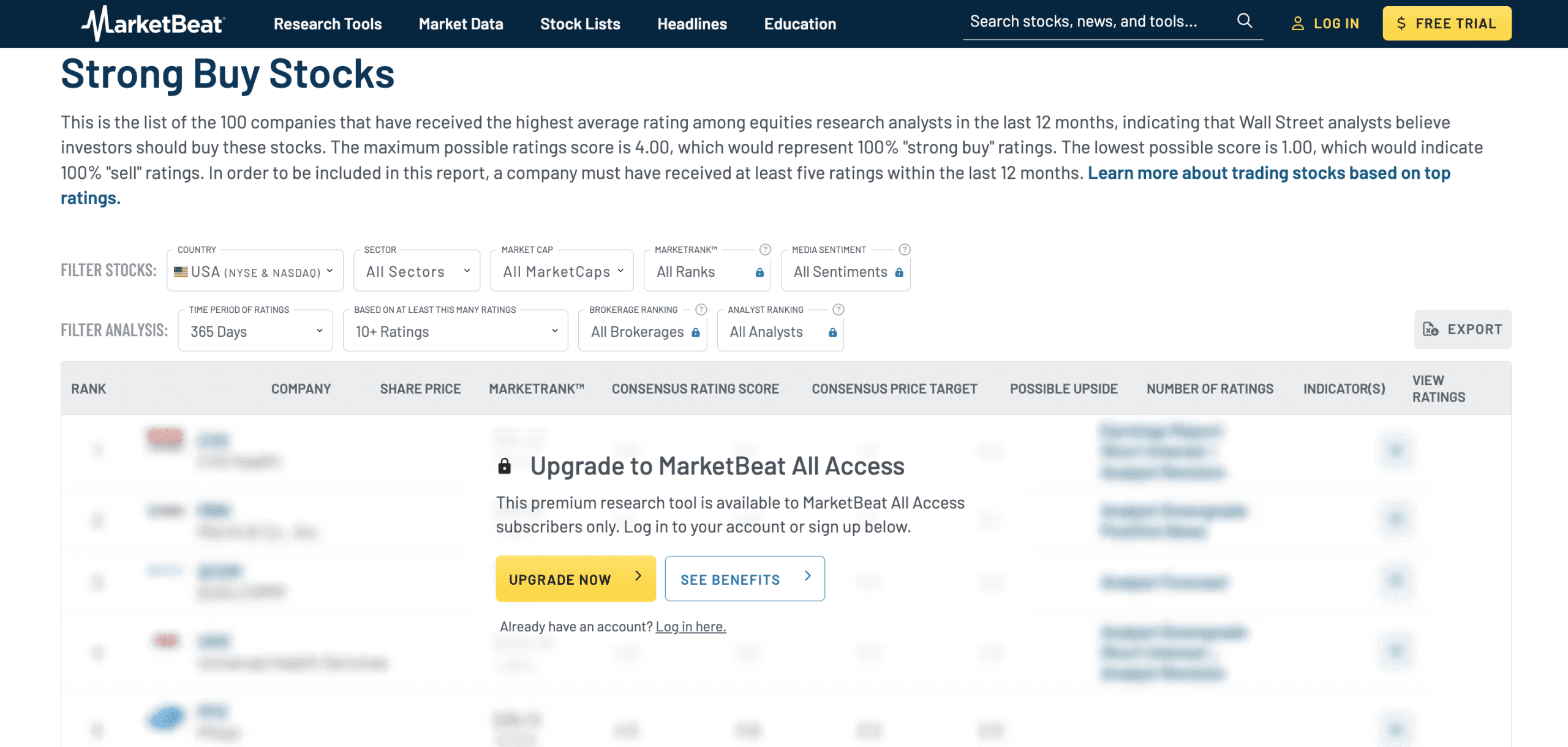
Get the email. Deliver value. Show them what they’re missing. Convert. This is the model that’s driving $60M a year.
How many marketers do you know who track which acquisition channel produces the most valuable subscriber — not just the cheapest one? How many can actually answer that question?
If you can’t answer it, you’re flying blind. Such a waste.
$1.4 million a month in paid. Here’s the actual playbook.
Organic traffic at MarketBeat sits around 50,000 visits a day.
Solid. Stable. Not growing fast.
The real growth engine is paid. $1.4 million per month across Meta, Google, Bing, TikTok, Taboola, and newsletter CPC platforms like Beehiiv. This year, Matt’s goal is to test 10 new paid channels — they’ve already got five running.
But this isn’t spray and pray. The playbook is disciplined:
- Ramp spend 10–20% per month
- Wait 90 days to evaluate cohort profitability
- Find the ceiling for each channel
- Pull back when efficiency drops
- Diversify before you need to
The reason for the 90-day window is important. When you put new dollars into a paid channel, it takes roughly three months to break even. And every channel has a natural ceiling — you don’t know what it is until you hit it. So you ramp slowly, watch the curve of how cohorts from November, December, January are performing over time, and adjust accordingly.
Test → measure → cohort-analyze → scale → cap → diversify.
That’s first-principles marketing. No shortcuts. No guesswork dressed up as strategy.
Oh. And one of the biggest growth unlocks MarketBeat had in the last year? SMS. They doubled down hard on it, and it paid off significantly. A channel a lot of media companies are still sleeping on.
For any growth-stage SaaS team reading this: paid isn’t evil. It’s not a crutch. It’s leverage — but only if you know your cohort data and your retention curves. Without that, you’re just burning cash and hoping.
With it? You’re compounding.
YouTube: 620,000 subscribers and just getting started
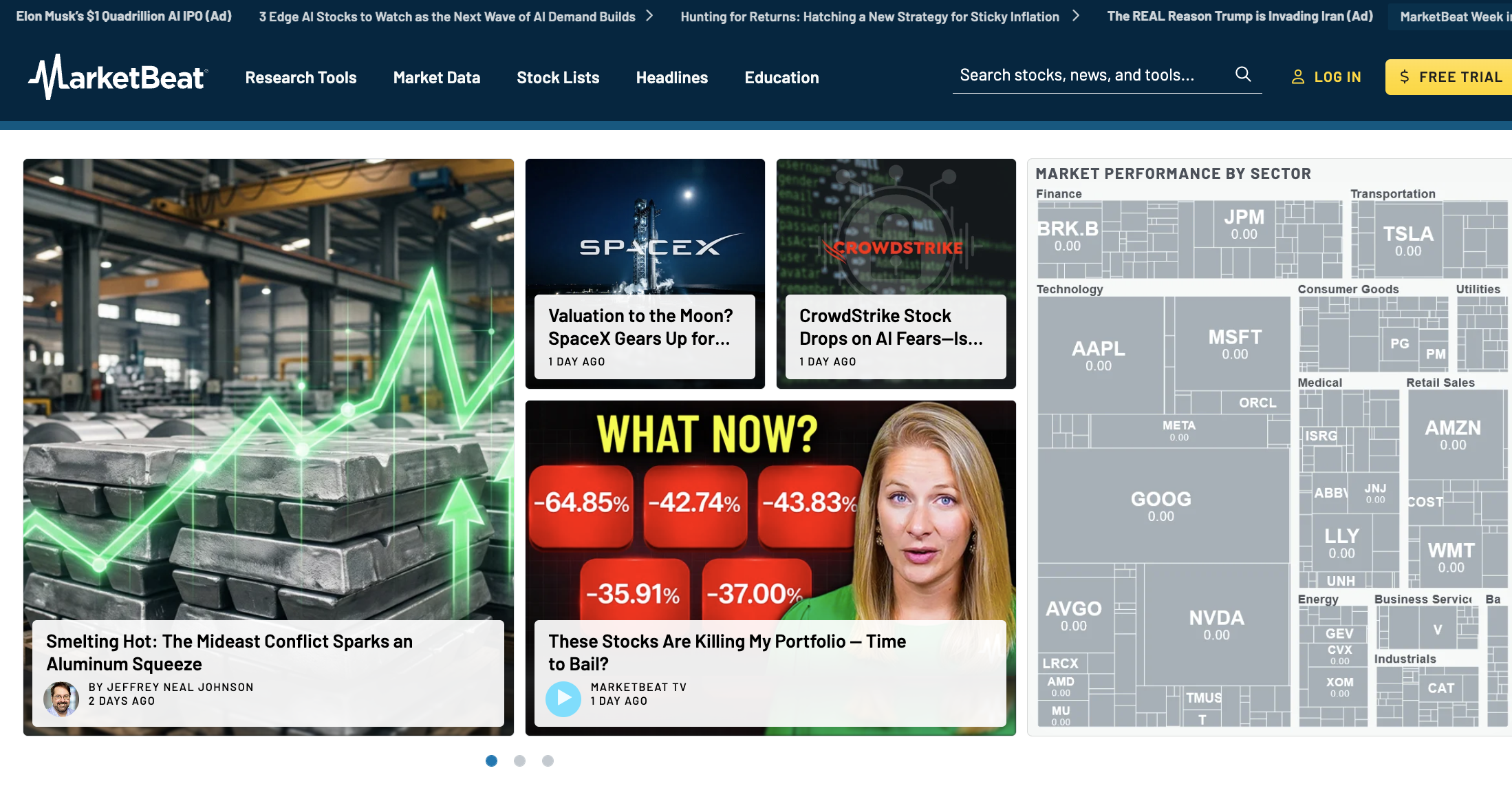
Take one look at the MarketBeat homepage and the content strategy becomes obvious.
Written articles. Data tools. And right there in the hero — MarketBeat TV. Video isn’t a side project anymore. It’s front and center alongside their core editorial content. That’s a deliberate signal about where they believe attention is heading — and where they’re investing accordingly.
This one deserves its own section because it’s a real distribution story in motion.
Three years ago, MarketBeat was barely on YouTube.
Today? 620,000 subscribers. And they’re going all in.
About a year and a half ago they hired a host — a local news anchor they recruited — and started producing interview-style financial content. It worked. Now they’re taking adjacent office space in their building, renting a couple thousand square feet, and building out a proper multi-camera studio with full lighting and production infrastructure.

Look at the thumbnail strategy here and you’ll see a media company that’s done its homework on YouTube. Bold text. A single consistent host. Urgent, emotionally-charged titles. “What Now?” “Money’s Moving Here.” “Buy Now. Last Chance.” These aren’t blog post titles repurposed for video — they’re built natively for the platform, designed to stop a scroll and trigger a click.
The production is tight, the cadence is daily, and the host is the same face every single time. That consistency is intentional. On YouTube, familiarity is the algorithm. The 620,000 subscribers didn’t happen by accident — they happened because someone made a deliberate decision to treat video like a real distribution channel, not an afterthought.
The plan is to use video to reach a slightly younger audience than their core email base, which skews toward 50–70 year old men. (Yes, they’re running profitable TikTok ads to that demographic. Yes, it’s working. Pretty cool.)
The broader distribution principle here is one worth writing down: start where the discoverability is, then move people to something you own.
In 2006, discoverability was on search. Today it’s YouTube and Instagram. So you build there — and then you send people from those rented platforms to an email list on Beehiiv or Kit that you actually control.
This isn’t a new idea. But MarketBeat is executing it at a level most media companies aren’t.
AI as infrastructure. Not a headline.
Every company is talking about AI right now. Most of them are using it to generate blog posts nobody reads.
MarketBeat’s approach is different.
They run three distinct content tiers:
Tier 1: Human-written content. Real writers, real editors. No AI anywhere in the process.
Tier 2: Template-driven automation. Structured earnings reports, data-heavy summaries — content that follows a repeatable format at scale.
Tier 3: Generative AI. Earnings call transcripts get summarized into articles using pure AI. High volume, low creative stakes, fast turnaround.
But the more interesting part is what Matt’s doing on the operations side.
He runs an OpenClaw agent named Multi. Every morning, Multi reviews his recent podcast interviews — like the conversation we had — interfaces with his Delphi AI clone, and writes six tweets based on what Matt said. Matt picks three or four. Multi schedules them throughout the day.
Multi also blocks driving time on his calendar so back-to-back meetings don’t get scheduled when he needs to travel between them. Puts gym time on the calendar so it doesn’t get crowded out. Logs into the MarketBeat admin backend, reads the internal reports, and flags anything that looks like a trend worth paying attention to.
I name my agents after DC Comics characters. Matt names his after the Molt days. The naming conventions are different. The philosophy is exactly the same:
AI increases throughput. Humans preserve authority. Build systems that compound.
That’s it. That’s the whole AI strategy for anyone who wants to use it right.
Your personal brand isn’t vanity. It’s infrastructure.
Paulson’s personal brand (the posting on X, the conference appearances, the growing following) doesn’t directly drive MarketBeat subscriptions.
He’ll tell you that himself…. We discussed in on the pod.
But here’s what it does drive: leverage.
Better vendor relationships. When you’re a known name, companies add APIs for you that didn’t exist before. When an algorithm flags your account and you get suspended, you can call someone who actually picks up. I’ve seen this in action too.
When my flight is delayed… I can send a DM and get on the next one.
When I go to a new city… I can always find someone I know up for a lunch.
When my team has a supplier or tech problem… I can usually email someone who can fix it.
MarketBeat spends hundreds of thousands of dollars a year on SMS providers, email platforms, infrastructure tools. When something breaks at 2am — and it will break — being a recognizable name means the difference between a fast fix and a support ticket queue.
There’s also the investment angle. Matt runs Homegrown Capital, a boutique VC fund with $40M under management. He attends conferences like New Media Summit not just to speak — but to find deals. His personal brand opens the room. His reputation closes it.
I’ve lived a version of this story. The Foundation brand and my personal brand aren’t the same thing.
But they compound each other. Every talk, every post, every piece of content I put out creates access that a cold email never would.
This isn’t about ego. It’s strategic positioning.
Don’t sleep on it.
Small town. Big numbers. Same story.
I’m from Preston, Nova Scotia. Population 3,536.
Matt is from Sioux Falls, South Dakota. Population of the entire state: 1 million people.
Here’s what Matt said that I haven’t been able to stop thinking about:
Being in a smaller market meant fewer distractions. No venture capitalists showing up to tempt him with term sheets. No scene to get caught up in. No pressure to jump to the next hot thing every six months.
He was able to stay focused on MarketBeat for years — building slowly, compounding quietly — in a way that he genuinely believes wouldn’t have happened if he’d moved to Silicon Valley at 22.
And because nobody offered him money to invest in the company, he bootstrapped it.
He now owns 100% of MarketBeat.
The “disadvantage” of being somewhere small became the thing that kept him on the path.
I’ve said this before and I’ll keep saying it: where you’re from doesn’t determine where you’re going. The internet is the great equalizer. The content is out there. The tools are out there. The access is there if you want it.
Get on a plane. Go to the conferences. Put the work in.
Then come home and build something that lasts.
Why most brands shouldn’t try to build a media company
When I asked Matt whether SaaS companies should try to build their own media brands, he didn’t sugarcoat it.
It’s very hard for non-media companies to build media brands. Full stop.
The operating model is just fundamentally different. In media, there’s no product — you’re optimizing for subscribers and engagement, not purchases. The cash flow timeline is longer. The metrics that matter are different. Most SaaS finance teams see the 90-day cohort windows and start having anxiety attacks.
His actual recommendation: acquire an existing asset or form a strategic partnership with one.
HubSpot did this right. They bought The Hustle. They bought Starter Story. And critically — they left those brands alone to run as they were. They didn’t absorb them into the HubSpot content machine and strip out everything that made them work.
That’s the move. Don’t bolt on a newsletter. Don’t hire a “content team” and call it media. Either buy a real media asset and protect what makes it valuable, or find a partner and become the anchor sponsor.
One more thing Matt said that should be the headline of every media strategy deck: “You don’t want cheap leads. You want good leads that stick around.”
The backend data — which channels send people who actually open, click, purchase, and stay — is the most underestimated thing in building a media company. Most people optimize for the lowest CPL. That’s not a strategy. That’s just a race to accumulate subscribers who don’t do anything.
Know your data. Protect your engagement. Build from there.
How he defines success now
After everything — the $60M revenue, the private jet, the Vikings suite, the VC fund, the community philanthropy — I asked Matt how he defines success today.
He didn’t mention revenue.
He didn’t mention the business.
He said: “How many days in a row do I really enjoy?”
That’s it.
The goal isn’t a number on a spreadsheet. It’s the ratio of days that feel good to days that don’t. It’s spending more time doing the things that light him up — being in the community, building with his team, writing code, going to games with his kids — and less time in the stuff that drains him.
He also said he’s never selling MarketBeat. Wants to run it until he’s done. Every acquisition in financial media has failed, he said, and someone else would just mess it up. He’d rather keep the cash flow train running and use it to do good in Sioux Falls for as long as he can.
That’s the long game, fully embodied.
Not the big exit. Not the liquidity event. Just a business you love, run well, for as long as you’re alive to run it.
What I take from all of it
Distribution is the moat. Build it intentionally.
Revenue per subscriber by channel is the metric. Everything else is vanity.
Paid compounds when you know your cohorts. Organic stabilizes. Both have a role.
AI increases throughput. Humans preserve authority. Know the difference.
Small teams win when the systems are strong. Ask whether it’s a people problem or a systems problem before you hire.
Your personal brand is infrastructure. It opens doors that no ad budget can buy.
And sometimes the most important thing you can do is just stay in the game long enough for the tide to turn.
Matt Paulson almost sold MarketBeat for $8 million in 2016 when it was doing $2M a year.
Nobody bought it.
So he kept going.
That’s the whole story, honestly. And it’s a better one than most of us will ever think to tell.