

Most B2B marketing teams spend their year on the pages furthest from revenue.
Blog posts. Glossaries. Thought leadership. All of it matters… and I’ve built a career telling people to create more of it and distribute it harder. But when a buyer is ready to pick a vendor, they rarely land on a blog post. They land on a pricing page, a comparison page or a product page.
I call these money pages. They answer transactional and commercial queries, the searches people run when the budget is approved and the shortlist is forming.
In AI search, they’ve become the most valuable pages on your site. Most companies still treat them as an afterthought the web team ships once and never touches again.
What is a money page?
A money page is any page built to carry a visitor toward a purchase decision. It speaks to one product, feature, audience or alternative, and it makes the case for why you’re the right pick for that problem.
It helps to see where these pages sit. Every B2B site breaks into four kinds of pages, and each kind has a different job.
| Page type | Its job | Examples |
|---|---|---|
| Money pages | Move a buyer toward a decision | Product, feature, use case, role, comparison, pricing, demo |
| Content pages | Attract, teach and earn attention | Blog, library, guides, reports |
| Support pages | Help existing customers | Help docs, status page |
| Culture pages | Recruit and tell the company story | About, careers, team |
Most visitors enter through content pages. Most revenue leaves through money pages. The mistake is funding the first group and starving the second.

Money pages exist to answer two kinds of searches.
| Query type | What the buyer is doing | Example searches | Page that should answer |
|---|---|---|---|
| Commercial | Comparing options before choosing | “best payroll software for startups”, “Brand A vs Brand B”, “Brand A alternatives”, “Brand A reviews” | Comparison, alternatives, role and segment pages |
| Transactional | Ready to act | “Brand A pricing”, “Brand A demo”, “Brand A free trial”, “buy Brand A” | Pricing, demo, signup and product pages |
Informational queries build the audience, and middle of funnel content keeps it warm. These two build the pipeline.
AI search moved the shortlist inside the answer
For a long time, AI Overviews mostly showed up on informational searches. The buying searches were left alone.
That window has closed. Semrush tracked 400 US commercial keywords for 12 months. In September 2025, 45.75% of them showed an AI Overview. By August 2026 it was 88%. “Best X for Y” searches reached 96.12%.
So the comparison now happens inside the answer. The AI builds the shortlist, and it builds it from the pages it can find and trust.

ChatGPT is heading the same way. Ahrefs studied about 15 million of its fan-out queries, the background searches it runs before it answers. Between August and September 2026, the share containing “price” rose from 6.04% to 8.88%. Searches for reviews grew by about a third. And when ChatGPT went looking on one specific site, 75.9% of the most common lookups pointed at a brand’s own website.
Read that again as a marketer. The model is visiting your site to find pricing, specs and proof. If those facts aren’t sitting there in plain text, it takes them from someone else.
The visits that do come through are worth more too. Ahrefs reported in June 2025 that AI search drove 0.5% of its traffic and 12.1% of its signups, a conversion rate 23 times higher than organic search. That’s one company and one 30-day window, so treat it as a signal… but it matches what a lot of us are seeing. People arrive from AI with the research already done.
The 7 money pages every B2B site needs
Here’s the set I’d build, in the order a buyer tends to need them.
1. Product and feature pages carry the core claim
One page per product. One page per major feature. Each one says what it does, who it’s for and why it beats the other way of solving the problem. These pages answer searches like “[category] software” and “[feature] tool”, and they’re the first place an AI model looks when it needs to describe you.
2. Use case pages meet buyers in their own words
Buyers search for the job they need done long before they search for your product name. “Expense approval workflow software.” “Customer onboarding checklist tool.” A use case page maps one job to your product and shows the outcome. If you solve six jobs, you need six pages.
3. Role pages speak to the person signing off
A CFO and an IT lead buy the same product for different reasons. One cares about cost and control. The other cares about security and setup. A page for each role lets you lead with the argument that person needs to hear. Your marketing personas tell you which roles deserve a page.
4. Segment pages prove you fit their size and industry
People describe themselves when they prompt. “Best CRM for a 20-person agency.” “Payroll for a fintech with contractors in three countries.” Pages by company size and by industry give the model something with a heading that matches. Startup, mid-market and enterprise is the usual split. Add the three or four industries where you win most often.
5. Comparison and alternatives pages win the shortlist
“Brand A vs Brand B” and “Brand A alternatives” are the closest thing to a buyer raising their hand. In the Semrush data, AI Overviews showed on more than 86% of “vs” searches and more than 82% of “alternatives” searches.
Write these pages the way a fair analyst would. Say where the competitor is the better choice. A page that reads like a hit piece gets ignored by buyers and by models.
6. The pricing page answers the question every buyer asks
Put real numbers on it. “Contact us” gives an AI model nothing to quote, so it quotes a review site or a forum thread instead. If you can’t publish exact prices, publish the starting price, the pricing model and what makes the cost go up.
7. Integration pages capture the stack-specific search
Nobody buys software in isolation. They buy something that works with the CRM, the ERP or the data warehouse they already run. One page per major integration answers “does it work with what I have”, which is often the last question before a demo request.
All seven should point to one destination, your demo or signup page.
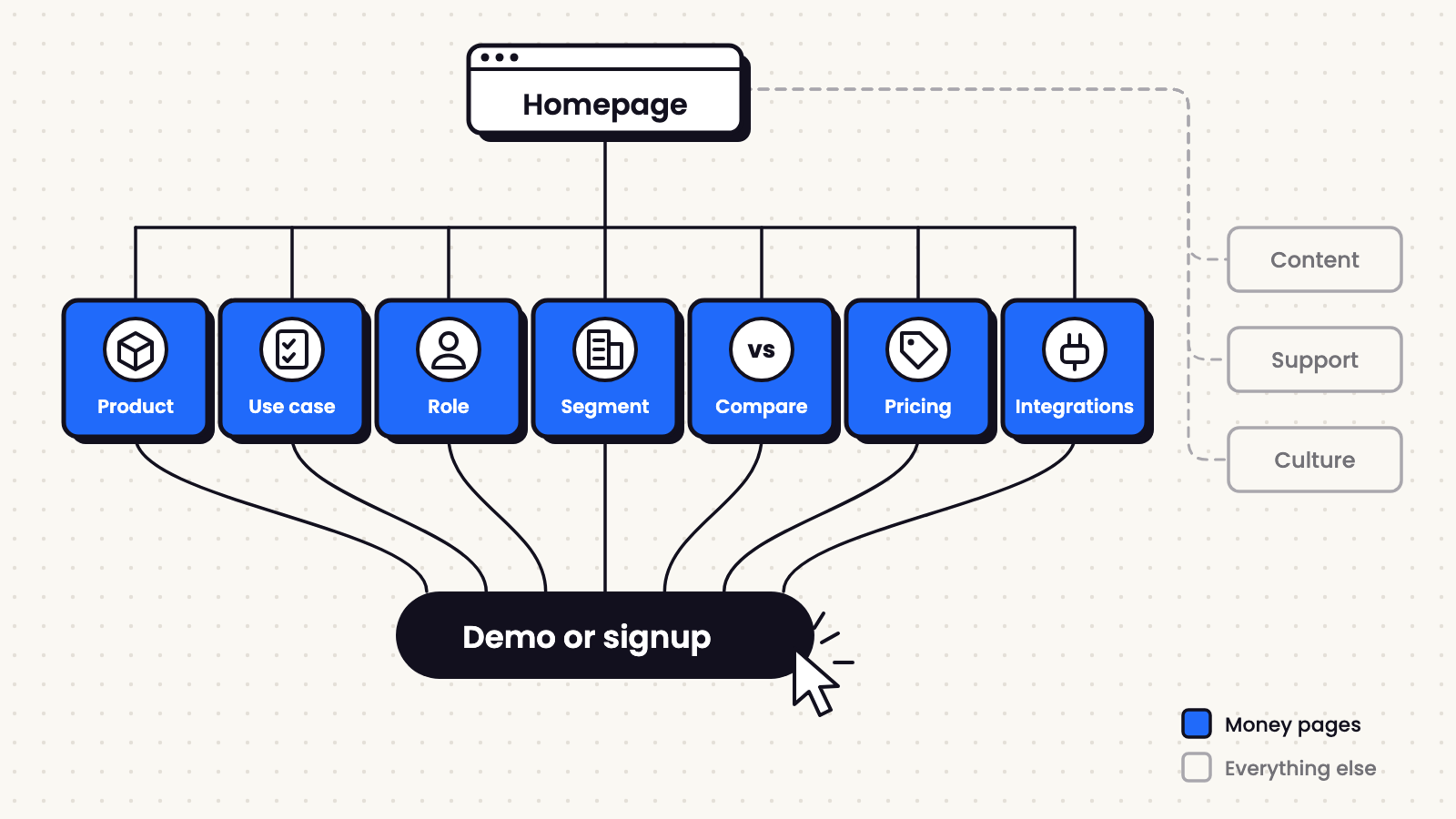
How to find the money pages you’re missing
When we run this research at Foundation, it starts with one number: how many monthly visits your competitors generate to their conversion pages. That number changes the conversation in the room. It turns “we should fix the product pages someday” into a line item.
Treat it like any content marketing research project. Start with what’s already working for someone else.
If you’re interviewing an AI visibility agency, ask them to walk you through these six steps. Here’s the process.
- Pull your competitors’ top pages and remove the blog. Use Ahrefs or Semrush, filter out content URLs, and look at what’s left. Those are their money pages and the searches that feed them.
- Tag every page by type. Product, use case, role, segment, comparison, pricing, integration. A pattern shows up fast. One competitor has 40 integration pages. Another owns every “alternatives” search in the category.
- Mark your gaps. List the types they have and you don’t, and the modifiers they rank for and you don’t: best, vs, alternatives, pricing, reviews, “for [role]”, “for [industry]”.
- Run the prompts. Take your 20 most valuable commercial searches and ask ChatGPT, Gemini, Perplexity and Google’s AI Mode. Record which brands get recommended and which URLs get cited. This is the step most teams skip.
- Listen to your sales calls. Every question a buyer asks before signing is a brief for a page or a section of one.
- Rank by distance to revenue. Pricing and comparison pages first. Then use case and role. Then segment and integration.
How to build a money page that gets ranked and cited
The on-page work is unglamorous. It’s also where most of the lift comes from. Think of it as Google on page SEO with a second reader… the model.
1. Match the heading to the search
AirOps analyzed more than 50,000 ChatGPT responses and found that pages whose best heading closely matched the query were cited 41.0% of the time. Pages with a weak match were cited 30.2% of the time. If the search is “payroll software for startups”, your H1 should say payroll software for startups.
2. Give each page one job
The same study found that pages covering 26% to 50% of the related subtopics were cited more often (38.2%) than pages covering all of them (34.0%). The giant everything-page loses to the focused one. That’s the whole argument for building seven types of money pages over one long product page.
3. Put the facts in plain text
Prices, plan limits, specs, integrations, security certifications. Write them as text on the page. Facts locked inside images, PDFs or tabs that only load on click are easy for a crawler to miss.
4. Answer in the first 100 words
Who it’s for, what it does, why choose it. A buyer skims. A model extracts. Both reward the page that says the thing early.
5. Put proof beside the claim
Customer names, numbers, review scores and case study links belong next to the statement they support. Proof stacked in a separate section at the bottom gets separated from the claim it backs.
6. Add a comparison table and real FAQs
Tables are easy to read and easy to quote. FAQs should come from sales calls and support tickets, word for word where you can. Mark both up with structured data so search engines can parse them.
7. Link your content pages into your money pages
Most visitors arrive through an article. Every article should hand the reader to the one money page that fits what they just read. Internal links also tell search engines which pages you consider most important.
8. Keep them current
A pricing page from two years ago is a liability. Set a quarterly review for every money page and show the date it was last updated.

What to measure
Traffic is the wrong scoreboard for these pages. A great comparison page might get 300 visits a month and influence more pipeline than your top blog post. Track four things.
- Rankings and organic visits to money pages, reported separately from the blog.
- Share of Model on your commercial prompts. How often you’re recommended, and which of your URLs get cited. The best AI visibility tools track this for you.
- AI-referred sessions that land on money pages, and what share of them convert.
- Demo requests and signups where a money page was the first or last page viewed.
The part that makes this hard
Money pages are harder to ship than blog posts. A blog post needs a writer and an editor. A pricing page needs product, sales, finance and sometimes legal in the same room. A comparison page forces you to admit in public where a competitor is stronger. That’s why these pages sit untouched for years while the blog publishes every week.
There’s a second limit. Your own site only gets you so far. In the Ahrefs data, official websites earned 63.4% of ChatGPT’s citations on factual questions and 46.4% on comparison questions. When a model weighs one option against another, more than half of what it cites comes from somewhere other than the brands involved.
So money pages are the first layer of AI visibility, the SEO, AEO and generative engine optimization layer. They put your facts on the record. The distribution layer decides what everyone else says about you… on Reddit, on YouTube, in reviews and in the press. That takes a Reddit marketing strategy, the right content distribution tools and patience. You need both layers.
But start with the layer you fully control.
Open your analytics this week. Filter out the blog. Look at what’s left. Those are the pages a buyer and an AI model both read right before the decision gets made, and they deserve your best work.