

Experts Say LLM Ads Will Never Work. History Disagrees.
OpenAI just announced that they believe they will hit $100M ARR from their initial six week ad pilot.
Skeptics say people will revolt. Skeptics say it’s silly to measure ARR. Skeptics say LLM ads are foolish.
And… While I agree that measuring ad revenue as ARR is strange. I think they’re wrong about the consumer shifts.
They have 600+ advertisers already and self-serve access is rolling out in April.
Facebook did $150M in all of 2007.
Last year Meta crossed $196 billion.
That gap…
$150M to $196B took 18 years.
OpenAI just opened the account.
And somehow… people still think LLM ads won’t work.
The Skeptic’s Case
The pushback is predictable. I’ve seen it in comments, heard it at conferences, read it in every newsletter that’s covered this story so far.
Nobody wants an AI recommending products. I’m asking a question, I don’t want to be sold something. It’ll feel gross. It’ll destroy trust. People will just use open-source models that don’t run ads.
I hear this. I understand it. But I’ve heard it before.
Almost word for word. About nearly every platform that ended up printing money on advertising.
We’ve Been Here Before
Let me show you something.
Below is a collection of things real people actually believed — confidently — before technology changed what they wanted.
- Nobody wants to just text someone instead of calling them. You lose tone, nuance, everything that makes communication human.
- Nobody wants to watch movies on a laptop. The whole point is the theater or TV, the shared experience, the big screen.
- Nobody wants to tell a stranger on the internet where they’re going. That’s not just weird, it’s dangerous.
- Nobody wants an algorithm to pick who they date. Love requires serendipity. You can’t automate chemistry.
- Nobody wants to ask their phone for directions. People want to learn a city. Half the joy is figuring it out yourself.
- Nobody wants to buy glasses or cars or clothes without trying them on. That’s a tactile, in-person decision. Full stop.
- Nobody wants a robot to drive their car. There’s something deeply human about being in control on the road.
- Nobody wants to read the news on social media. That’s for cat videos and science stuff.
Smart people thought these things.
Smart people still think these things and apply their worldview to the global circumstances…
Technology doesn’t just change what we do. It changes what we want.
We didn’t want to text because we’d never really texted. The moment we did… we never stopped.
SMS became iMessage became WhatsApp became Slack became DMs. And now a full generation struggles to make a phone call. Something that was a core human behavior…
Hearing someone’s voice has been displaced by something many said felt inferior.
Yet… More couples text every night vs. talk on the phone. Texting has become the PRIMARY form of communication for couples.
Streaming did it to the movie theater. Not killed it, but reshaped the physics of it.
You now go to theaters for huge films and stay home for everything else…
Nobody planned that. It just happened.
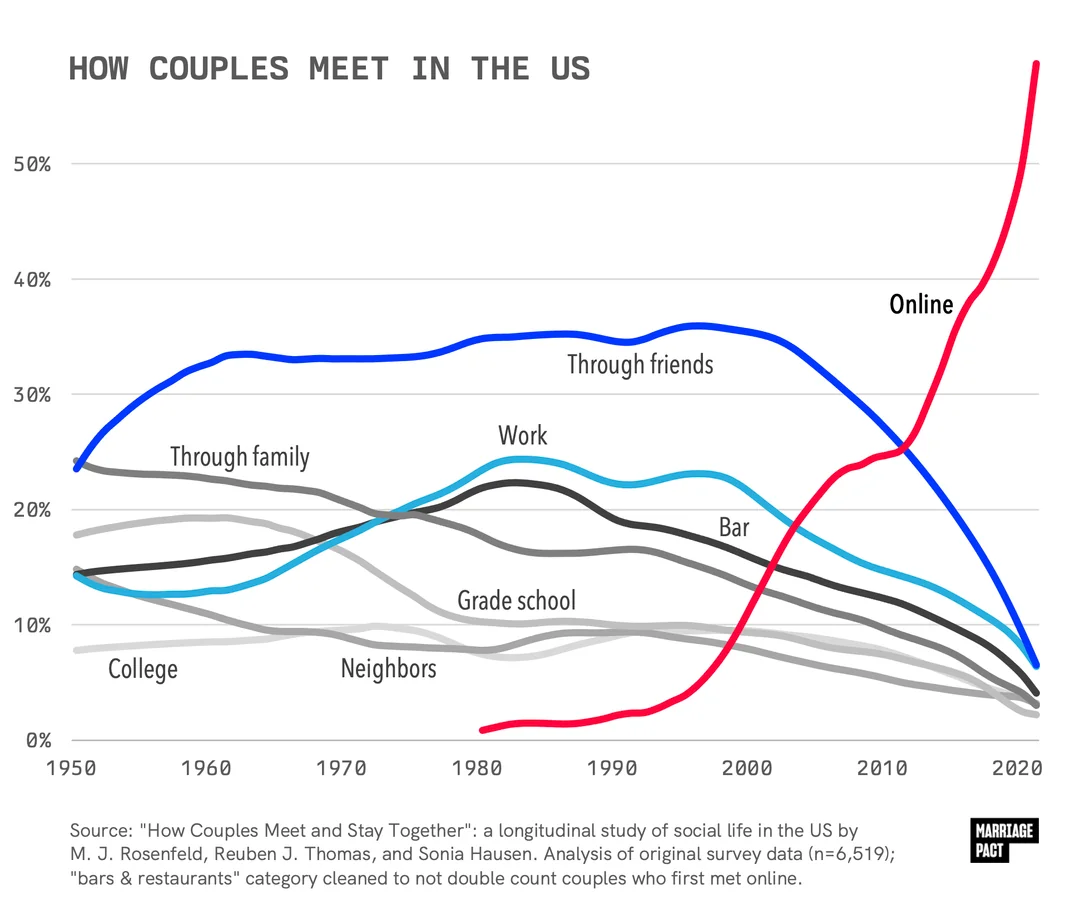
Online dating did it to the bar scene. A generation of people meet their spouses on apps. Nobody thinks that’s weird anymore. The thing that felt deeply unromantic… became the most common love story of our time. The data speaks volumes:
Wikipedia did it to expertise. We used to call a professor, or go to the library, or defer to whoever in the room sounded most confident.
Now we search. Then verify on Reddit. Then increasingly… ask an LLM.
The epistemic chain has shifted entirely and we’re only partway through the shift.
GPS didn’t just change navigation. It changed spatial memory itself. Whole generations are growing up without needing to know where anything is. They just ask. The skill atrophied because the tool made it unnecessary…
The pattern across all of these is the same. The new behavior feels worse at first. Then it feels normal.
Then the old behavior feels strange.
Why LLM Ads Are Actually Better Than Search Ads
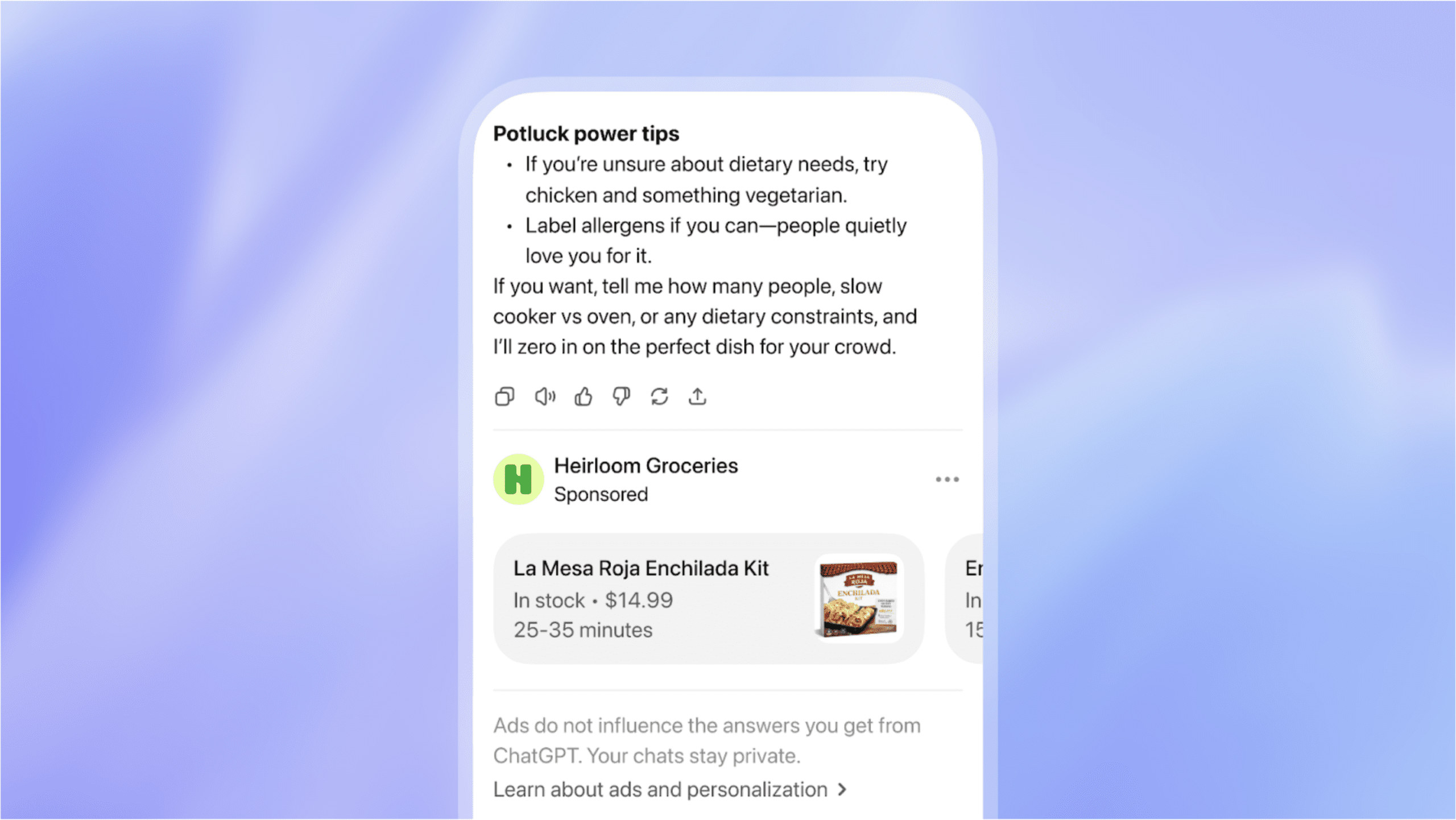
Here’s what search ad veterans understand that LLM skeptics don’t:
Context is the entire game.
Google’s ads work because they catch you in a declared moment of intent. You search “best CRM for small teams” and HubSpot shows up. That works because the query revealed something about you. The more specific the query, the better the ad performs.
- Search query: “best CRM for small teams”
- LLM prompt: “I’m scaling a B2B sales team from 3 to 15 reps. We close enterprise deals over 90-day cycles, need Slack integration, and our ops team hates heavy admin. What CRM makes sense?”
That second input isn’t a just a phrase or keyword. It’s a customer brief delivered to a system…
It contains company size context, sales motion context, tech stack context, and buying criteria… All written (or said) by the user.
Google has never had that much signal from a single query in its history.
The ad (or recommendation, or sponsored answer) that can live inside that moment isn’t going to be seen as an interruption.
Done right, it’s the answer….
The right answer.
And recommendations from trusted, contextually-aware advisors? People follow those.
That’s the entire premise of influencer marketing and it’s worth tens of billions of dollars a year.
How LLMs Win The Long Term Data Fight
This is where it gets genuinely interesting… When you map Meta’s data collection layers against what LLMs are already sitting on…
LLMs win on almost every dimension. They just haven’t built the monetization or daily usage infrastructure needed yet.
Meta spent 20 years and billions of dollars building the most sophisticated data collection machine in human history. And for most of that time, nobody came close…. But there’s a problem with inferring what people want from their behavior…
Behavior is a bad proxy for intent. This is why Google and Ads work so well. The intent is clear when someone types: “Best CRM Software” what they want… But Google hasn’t had the layer of social context that Facebook had. LLMs don’t have either problem.
When you map what Meta actually captures against what LLMs are already sitting on after six weeks of an ad pilot, the comparison isn’t even close…
1. Declared Interest Data
Meta infers your interests from likes, follows, and page interactions.
It’s behavioral signal that has to be decoded. You liked a post about running shoes… maybe you’re into fitness.
Maybe you’re just a fan of the brand. The inference is noisy.
When you talk to an LLM, you just… tell it. “I’m training for my first marathon. I’ve been dealing with shin splints and I need a new pair of shoes.” That’s not inferred interest. That’s declared intent with context, pain point, and purchase signal all in one message.
No algorithm needed. And it gets stored in the LLMs memory.
2. Life Stage and Life Event Data
Meta catches life events through status updates and you deciding to give it information like your birthday, graduation year, etc… You change your relationship status to “Engaged” and suddenly you see wedding ads. That’s reactive targeting off a single data point.
But LLMs get the full narrative. “My partner and I just got engaged, we’re thinking of a destination wedding in Italy, budget is around $40K, her family is flying from the Philippines.” That’s not a life event flag.
That’s a brief that any luxury travel brand would pay serious money to be inside.
3. Financial and Purchase Intent Data
Meta infers income brackets from zip code, device type, and spending behavior patterns. It’s a proxy signal at best.
LLMs are being asked directly. “Is a $2.5M whole life policy worth it for someone at my income level?” or “What’s a reasonable budget for a kitchen renovation in a 2,400 square foot home?” The financial context volunteered inside LLM conversations dwarfs anything Meta captures through behavioral inference. People are going so far to upload their entire bank accounts to an LLM and ask: “What stocks and bonds should I actually be buying right now?” This data is absolute gold for an ad buyer.
4. Professional and B2B Data
This is LinkedIn’s whole moat. Job title, company size, industry… that’s the targeting trifecta for B2B advertisers. Meta is weak here. And LinkedIn charges a premium specifically because it owns this. But I think the LLMs are going to put up a strong fight against LinkedIn when it comes to running ads that reach B2B buyers where they are.
LLMs are capturing it through conversations. “I’m a VP of Engineering at a 200-person SaaS company called [NAME] (look us up), we’re on AWS, we’re evaluating moving our data warehouse from Redshift to Snowflake, what should I know?”
That’s more B2B targeting signal in one prompt than LinkedIn can infer in a year of profile activity.
5. Off-Platform Tracking
Meta’s biggest superpower is the Pixel. It follows you around the web and stitches your offsite behavior back to your profile.
That took years to build and is now under regulatory siege everywhere.
LLMs don’t need off-platform tracking because the conversation is the platform. Everything happens in the session. The signal comes to them. And as LLMs get embedded into browsers, into operating systems, into workplace tools… the session becomes ambient. The context window grows to include your whole digital life. That’s not surveillance. That’s just… the product working.
6. Cross-Device Identity
Meta stitches together your identity across phone, laptop, and tablet through device IDs, cookies, and login matching.
That’s complicated infrastructure. It breaks when Apple changes its privacy rules.
An LLM that’s logged in is already cross-device by default. Your conversation history follows you. Your preferences are persistent. The identity graph is free.
The Business Case Is Already Written
Google launched AdWords in 2000. It generated roughly $70M in its first year. Google’s market cap is north of $2 trillion today.
OpenAI’s ads pilot is 6 weeks old and it’s said to be able to do $100M thi syear.
Self-serve opens in April…
They have 600 advertisers before the product is even broadly available.
The trajectory isn’t just similar to Google. I think it’s steeper.
But I think Gemini…
Perplexity.
Claude.
Manus.
Grok.
Reddit Answers.
And all the other technologies could put up a fight just the same.
Because the context is richer, the session time is longer, and the interaction depth is categorically different from a search query.
People spend 5 to 10 minutes in an LLM conversation. They spend 30 seconds on a traditional search results page. AI Overviews and AI Mode are changing that quickly…
But more session depth means more surface area for relevance… More relevance means better ad performance. Better ad performance means higher CPMs. Higher CPMs means a bigger business.
Facebook built $196B in revenue by putting ads next to status updates.
The LLM companies are putting ads inside the answer itself. One of those is obviously more valuable.
Here’s How We Need To Think About This…
The question isn’t whether people will accept ads in LLMs…
The question is how long before the LLM companies fully internalize that the floor for what they’re sitting on is a $200B+ annual business…
And start building distribution infrastructure to match it.
History doesn’t repeat. But it rhymes pretty loudly sometimes.
Facebook took 18 years to go from $150M to $196B.
I don’t think it’ll take LLMs 18 months to prove this category out.
The people betting against LLM ads are making the same bet that every generation makes when they look at a new behavior and project their own current preferences onto the future.
It almost never works out for them.