

Canada is losing its entrepreneurial soul.
The country has 100,000 fewer entrepreneurs than two decades ago despite adding 10 million people, its provinces rank below all 50 U.S. states on economic freedom, and the middle class is drowning in record household debt while government expands at twice the rate of the private sector. Here’s the reality:
The C-Word… Capitalism.
Needs to be embraced. Not rejected by Canadians.
Let’s start with the fact that should blow all of our minds from BDC:
Canada has 100,000 fewer entrepreneurs today than 20 years ago, even as the population grew 28%.
The new entrepreneur rate has been cut in more than half. It went from 3 per 1,000 Canadians annually in 2000 to just 1.3 per 1,000 in 2022. BDC Chief Economist Pierre Cléroux warned this
“Simply can’t be ignored, because new businesses are responsible for almost all net new job creation in this country.”
But unfortunately… The trend is accelerating. Earlier this year, Statistics Canada published data that should wake everyone up:
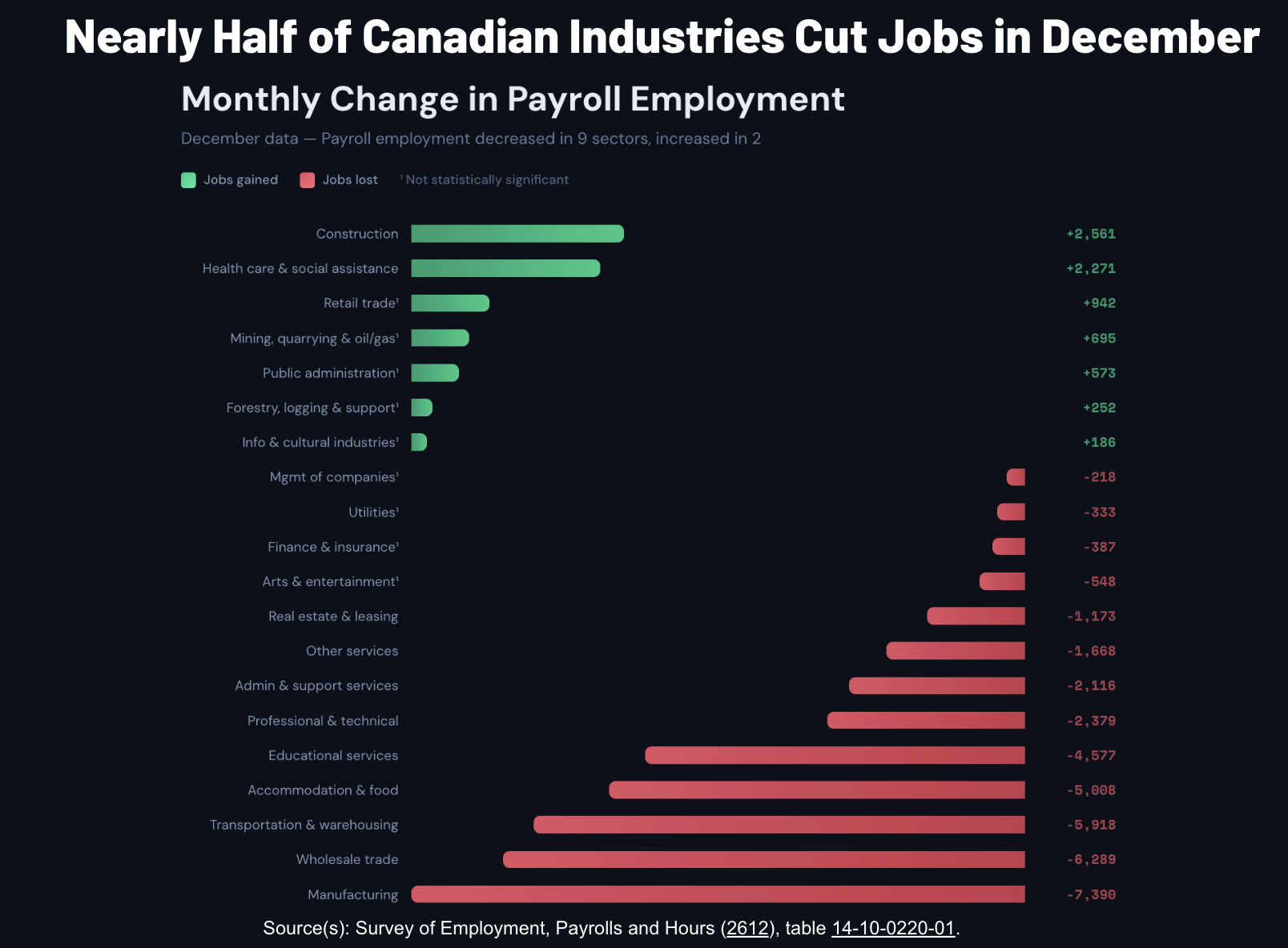
Almost every industry is seeing significant cuts except for health care & construction.
According to Statistics Canada data through October 2025 the business opening rate dropped to 4.5% while closures rose to 4.9%.
And then this month… We just saw this news:
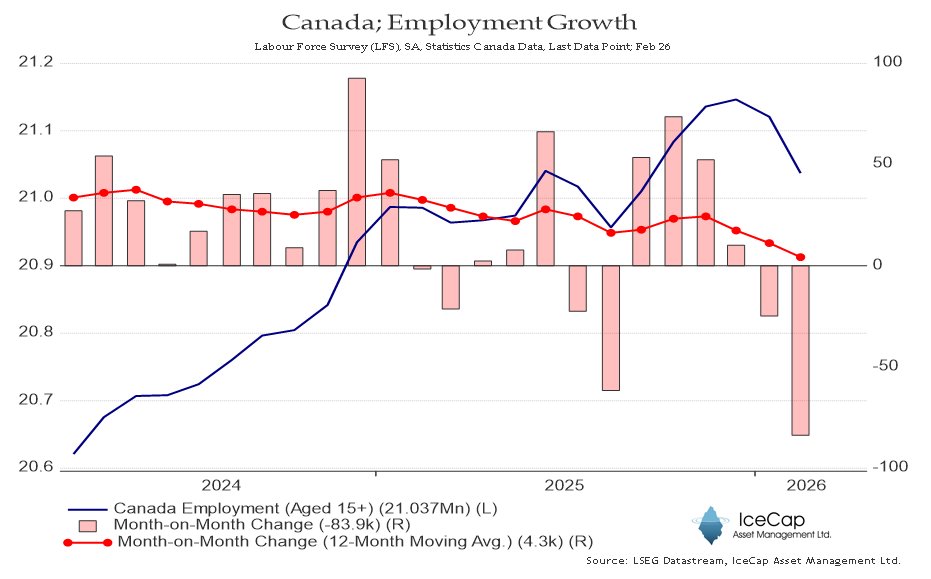
Employment declined by 84,000 (-0.4%) in February and the employment rate fell 0.2 percentage points to 60.6%.
The unemployment rate increased 0.2 percentage points to 6.7%.
Our businesses are closing at a rate higher than our businesses are opening.
So when the CFIB confirms five consecutive quarters of negative net business creation through Q1 2025 and the Globe & Mail finally asks the question:
Out of nowhere, Canada became poorer than Alabama. How is that possible?
The answer should be obvious…
We have more businesses dying than being born, in every province except Quebec…
Self-employment tells the same story.
The self-employment rate has fallen from a peak of 17.2% in 1998 to 13.2% in 2023. But here’s some good news (sarcasm) since January 2019, public-sector jobs rose almost 25% while our private-sector payroll positions increased 10%…
The number of self-employed Canadians actually declined.
Business insolvencies surged to 6,188 in 2024 (spoiler – that’s the the highest since the Great Recession) and is a 28.6% jump from 2023. And while it’s just the opinion of a small minority in Canada…
Its reported that 67% of small businesses cite tax and regulatory costs (aka the government) as their top constraint.
Which takes us to the one thing growing in Canada…
Our Government grew while the private sector struggles
Over the past decade (2015–2024), public sector employment expanded by 27.0%.
This is twice the private sector’s gain of 13.4%. The Canadian added 950,000 government jobs in the last decade, accounting for 30% of all employment gains in the country. The public sector’s share of employment rose from 19.7% to 21.5%, while self-employment shrank from 15% to 13%.
The federal government alone ballooned from roughly 257,000 employees in March 2015 to 367,772 by March 2024.
This is a 43% increase against a 14% population growth.
The CRA alone added 14,000 employees (a 34% increase) between 2019 and 2023.
Look:
I’m not hating on government / public sector employees.
The Government is one of the best employers in the country. It’s not on the employees. It’s the system that feels broken.
Think about this comparison. California and Canada have almost identical populations. We both hover around 40–41 million people. Yet the public sectors look quite different. Both governments are considered to be left leaning. But here’s a very key difference:
According to Calbright College, California’s state and local public sector is the second-biggest industry in the state by employment, with a workforce of 2.3 million. That figure excludes federal workers employed within the state. If you include the federally-supported jobs (roughly 350,000+ federal civilian workers based on California’s share of the U.S. population), you’re looking at around 2.6–2.7 million total public sector workers, or roughly 14–15% of the state’s workforce.
On the maple syrup side:
As of September 2024, Canada’s public sector employees totalled 4.4 million, or 21 percent of the total workforce.
Despite being virtually identical in population, Canada’s public sector is roughly 60–70% larger than California’s in absolute headcount, and meaningfully larger as a share of the workforce (21% vs. ~14–15%).
I know it’s not apples to apples comparisons.
But whether we compare Canada to California for GDP or % of private vs. public…
Whether we compare Canada to Alabama for GDP or cost of living…
Whether we compare Canada to Pennsylvania for total number of MRIs available…
We’re losing in a lot of categories vs states smaller (or similar size as us) that we should be winning.
And the best way to win?
A stronger private sector.
Let me be very clear:
I’m not saying anyone deserves to have their job cut.
But as a country we’re in a crisis.
Canada’s public sector now claims 21.8% of the workforce as of January 2026.
That’s one in five.
And the total number self-employed is on a massive downfall:
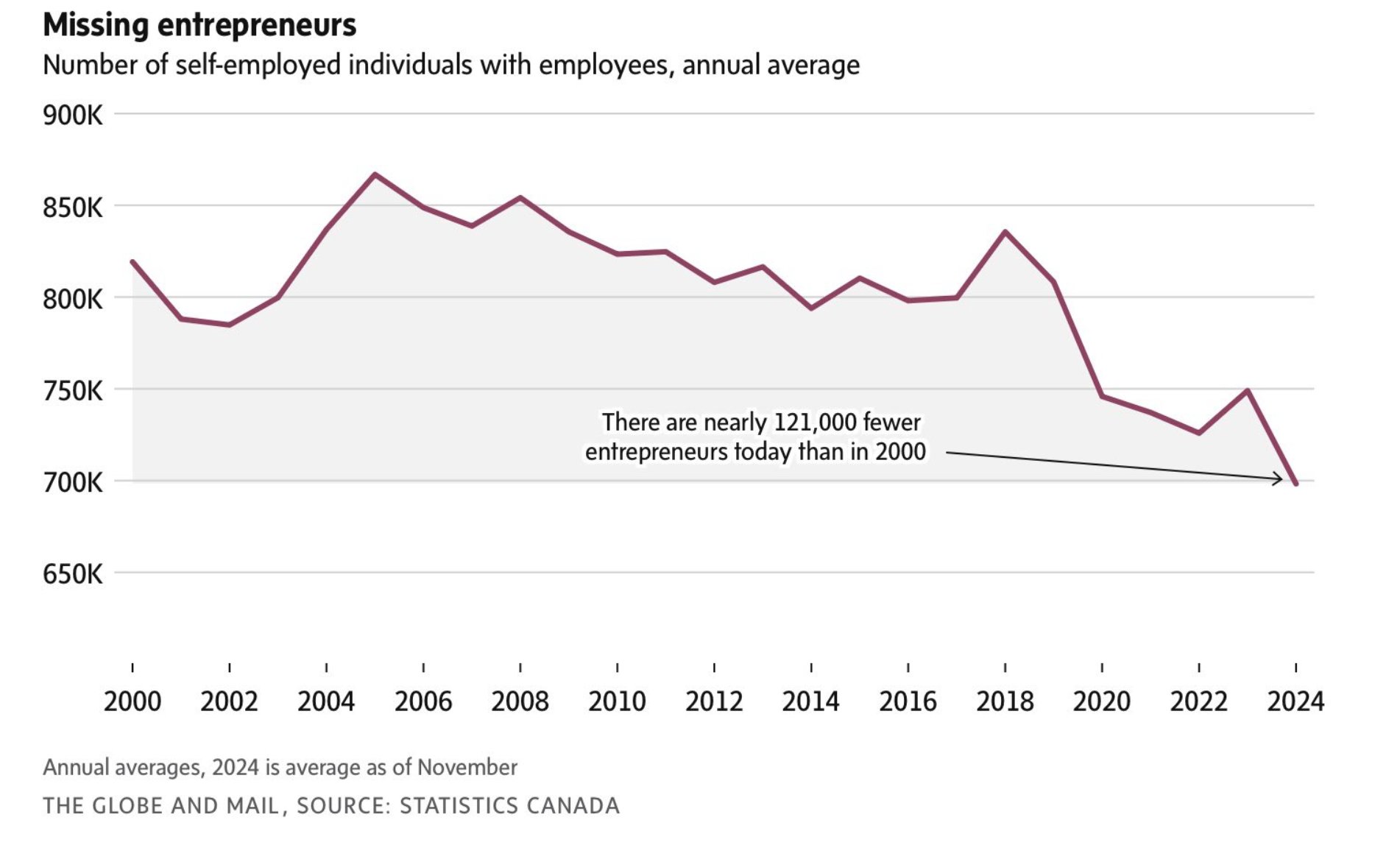
It’s true we don’t have the best climate for self-employment but it’s still pretty good.
Free healthcare.
Limited bureaucracy to start.
Similar tax levels to other socialized countries.
But the “Canadian dream” for some reason is to get a pension in the government rather than build a business that pays you through retirement.
This isn’t how it should be.
Let’s fall in love with Capitalism again because it’s the private sector that pays for everything.
And unfortunately…
Out of those who pay for everything… It’s the ones who win at the game of capitalism.
Over 65% of all taxes in Canada are paid by the top 20% of earners.
Let me say that again:
Over 65% of all taxes in Canada are paid by the top 20% of earners.
If you love this country and want this country to thrive with all the social benefits and safety nets… The # 1 thing you can do is to create so much wealth and income in the private sector that you’re paying taxes with the tax filers in the top 20% covering 65% of the bill.
The private sector taxes fund the salaries, pensions, hospitals, healthcare and schools.
The private sector funds the food programs, the social justice programs, the rebates, the senior programs, the government backed scholarships, the subsidized housing and all the endless programs Canadians use every day. Every hospital bed, every teacher’s salary, every pension check… It’s the private sector that foots the bill through taxes, innovation, and jobs that actually create economic value that the system rewards with financial gain.
Pause.
I know some of you are already triggered.
I’m not saying that public sector roles are not valuable.
I’m not saying that public services are not valuable.
I’m talking about economic value.
Money.
The thing that needs to be spent to get all the services no one wants cut.
Economic value is created in the private sector.
In any economic system (especially one like ours) real, sustainable value comes from producing goods and services that people voluntarily pay for, from innovating solutions to problems, from taking risks to build something that generates revenue and employs people.
That’s where wealth (and taxes) originate.
The public sector is essential for redistribution, infrastructure, safety nets, and collective goods… I don’t deny that. But it doesn’t create net new wealth for the Provinces or Country at large. This is why we need to fall back in love with Capitalism.
The government just reallocates and sustains what the private sector has already produced through taxes and economic activity.
Capitalism rewards value creation with profit, which incentivizes more of it. When we glorify secure government jobs and defined-benefit pensions as the ultimate goal, we subtly discourage the very risk-taking and innovation that keep the whole system funded and growing.
Canada actually punches above its weight in early-stage entrepreneurial activity compared to most G7 peers (often ranking at or near the top in recent Global Entrepreneurship Monitor reports), yet too many still see the “safe” path as the aspirational one.
Yet here we are:
Public jobs ballooned 27%+ since 2015 (twice the private sector’s pace), while self-employment slides, new business starts crater, and exits outpace entries for five straight quarters through early 2025 (with trends persisting). Businesses are dying faster than they’re born. Insolvencies hit Great Recession highs in 2024.
Entrepreneurs?
We’re down 100,000 net from two decades ago, even with 10 million more people.
This isn’t sustainable.
It’s a slow chokehold on the dreamers, builders, and risk-takers who actually create wealth.
If we want to keep the good stuff (universal healthcare, a good Hockey program [cough, cough], strong social programs, high quality of life), we have to keep celebrating and enabling the people who create the value that pays for it all.
We need more builders.
We need more creators.
We need more innovators.
We need more entrepreneurs.
We need to stop yelling & arguing about whether capitalism is good or bad. The debate is pointless. We live in a capitalist driven world.
We can pretend to opt out… And fail as a nation.
Or we can lean into the reality that productivity matters, resources matter, value creation matters…
And get back to being one of the most envied countries in the world.
KEY FACTS THAT LED TO ME PUBLISHING THIS PIECE:
- Small & Medium business generate roughly 50% of Canada’s GDP and account for 64% of total private-sector payroll employment (Fraser)
- In 2014, the US produced roughly 24% more per person than Canada. By 2024, that gap was 50%. The largest since World War II.
- In the early 1980s, Canada was roughly 88% as productive as the US; by 2022 that had fallen to 71% and continues to decline. (Fraser Institute)
- An estimated 126,340 people moved from Canada to the United States in 2022. A 70% increase over the prior decade and a 10-year high. (CBC)
- Canada’s net inflow of high-net-worth individuals (liquid investable wealth ≥ US$1M aka big tax filers) collapsed to approximately +1,000 in 2025. A 69% drop from 2024’s +3,200 and the lowest figure on record excluding the pandemic. (Better Dwelling)
- We need more Physicians but a mass exodus is projected. The physician pay gap. A Canadian family physician nets roughly C$179,000 after overhead, versus an average of ~C$330,000 in the US.
- Once among the poorest countries in Western Europe, Ireland cut its corporate tax rate from 40% to 12.5% (phased in 1996–2003). Canadian Accountant GDP per capita (PPP) surged from approximately $29,600 in 1990 to $115,300 in 2024. (Canadian Accountant)