

You know that moment when you realize something you’ve been saying for 10+ years isn’t contrarian anymore?
It’s just… obvious.
Last month, an anonymous developer built a basketball game in a few hours using AI tools.
Zero marketing budget. Zero audience. Zero fanfare. By Friday, it was the #1 trending sports topic in America.
It beat the NBA Finals for attention. NBA players were posting their lineups. ESPN, Bleacher Report, Sports Illustrated were covering it. And by Monday, there were a dozen clones spinning up across football, hockey, soccer, and baseball.
That game is called 82-0.
And it’s the clearest proof I’ve ever seen that production gatekeeping is dead.
Distribution is now the only moat that matters.
Let me show you what happened. And why it matters for how you build in 2026.
How a Game Nobody Planned Became the Biggest Sports Moment
Here’s what 82-0 is: you hit spin. A slot machine lands on a random NBA franchise and decade (1960s-2020s). You pick one player from that era. You do that five times. Then an AI scores your lineup across every basketball stat that matters…
Points, rebounds, assists, steals, blocks, defense. You either go 82-0 (perfect season) or you don’t. That’s it.
No download. No login. No paywall. One click and you’re playing.
It launched during the 2026 NBA Finals and spread like nothing I’ve seen in years…
The virality reminded me of the hype around Angry Birds, Jetman (iykyk) and Pokemon Go.
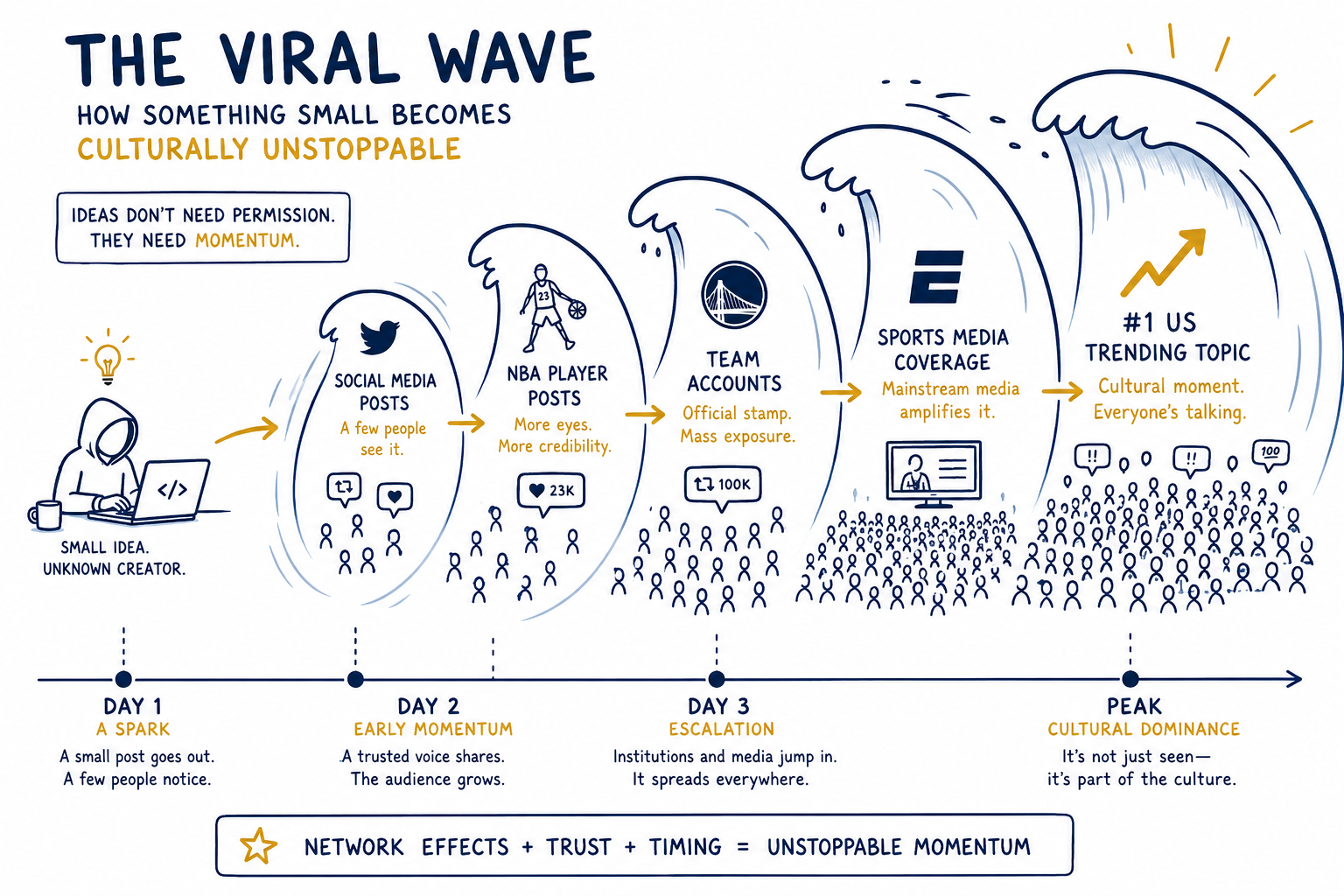
First across X and Reddit. Then NBA players started posting their rosters. Tyrese Haliburton went 82-0 and tweeted about it. The Bucks posted their lineup. The Warriors did too. Dan Le Batard, Nick Wright, and every NBA content creator with an audience followed suit…
By Thursday morning, 82-0.com was the #1 trending topic in the entire United States!!
Huge right?!
Why did it take off? Because it was fun, shareable, and designed for virality from line one.
The results are screenshots. The logic is debate-bait (which era was strongest? who’s the GOAT?). It’s low-stakes bragging rights only. And anyone could play in seconds. That’s the formula. Not polish. Not production value. Shareability…
But I’m not here JUST to talk about the game.
Let’s talk about some of the impact this has on creators… Especially SaaS founders & makers.
The Cloning Opportunity: Going From Months to Hours
Within 2-3 days, someone built 20-0. An NFL version.
Within a week there was 98-0 (NHL), 8-0 (World Cup), and baseball variants.
Each one was built by someone who saw 82-0, thought “I can do that for my sport,” and did it.
Folks.
This used to take months.
Building a clone used to require hiring developers, negotiating timelines, shipping a product. Now? Hours.
This strategy isn’t new. It’s just faster now.
Rocket Internet, the Berlin-based startup factory, built an estimated $3.05B market capitalization by doing exactly this. Rocket Internet perfected the act of cloning proven business models (Uber, Airbnb, Spotify, Zalando) and shipping them to markets faster than anyone else. They didn’t invent the models. They cloned them and invested in distribution to dominate regions that were relevant to them.
The difference between then and now?
Rocket Internet required capital, teams, and months to clone.
Today, AI coding tools let a single person clone in hours.
The barrier to entry collapsed even further. The advantage compounds for whoever moves fastest and distributes smartest.
The implication of this should feel massive for anyone with an ounce of ambition.
It means the moment you get traction, the moment something works, competitors with the same AI tools can copy it instantly. Your only defense is speed, distribution, and constant iteration. Not secrecy. Not complexity. Not a “moat” that takes months to build.
The fastest way to kill an idea now isn’t to copy it. It’s to ignore it….
How Vibe Coding Is Changing the Entire Game
Here’s what nobody was talking about two years ago:
Production is becoming free.
Claude Code crossed $2.5B in annualized run-rate by February 2026. That’s less than 18 months from launch. In the same period, Anthropic’s own engineers started shipping 8x more code per quarter. And get this: in May 2026, over 80% of the code merged into Anthropic’s production codebase wasn’t written by humans. It was written by Claude.
Developers documented building full multiplayer browser games in 30 minutes. Complete games in two evenings. Games with custom mechanics, multiple screens, interactive logic. Things that used to take weeks of engineering.
And they’re not alone. Cursor, v0, Bolt, Lovable, Replit — every major AI coding tool is seeing the same trend.
You can sit down with an idea and a prompt and have a deployed product in hours. The result?
A ton of new apps. But most of these apps aren’t getting traction:

Yes, the AI tools are amazing.
The old hard part is becoming easy. And when the hard part becomes easy, the competitive advantage moves somewhere else.
As you can see in the image from FT, the app releases are up but the apps with usage and reviews are down.
So…
The edge is no longer building.
The edge moves even more aggressively to distribution.
Social Media as the New Distribution Storefront
82-0 never touched an app store.
No app store review process. No feature placement. No marketing budget. No publishing deal. Nothing.
It spread through X and Reddit… then almost every other channel.
Someone posted it here & there. NBA players found it and posted their lineups. That went viral. Then NBA team official accounts posted. Sports media covered it. Each layer of attention made the previous layer look bigger, which pulled more attention down.
That’s organic distribution at scale.
That’s what happens when your product is so frictionless and shareable that it spreads at the speed of a tweet.
Compare that to traditional gaming distribution: you build your game, you submit to the App Store or Steam, you wait weeks for approval, you hope for a feature placement, you maybe get some review coverage, and then you hope people find it. The distribution path is controlled by gatekeepers. The timeline is slow. The reach is limited unless you pay for ads or have an audience already.
With 82-0, there were no gatekeepers. One click and you’re playing. One screenshot and you’re spreading it. One post and millions of people see it.
The team at a16z calls this
Distribution moving at the speed of a tweet.
And they’re right. The moment your product is good enough to share, the moment it’s frictionless enough to play, social platforms become your distribution channel. And this is the new storefront.
The Three Keys: Production, Distribution & Taste
Here’s what I’ve been saying since 2014: Distribution Rules Everything Around Me.
I said it when people thought I was crazy. When content marketing was supposed to be about perfect blog posts and huge production teams. When coding & writing was the constraint. When you couldn’t compete unless you had capital, engineers, and time…
That was the world where production mattered a whole lot more than it does today.
Now? Look at what actually happened with 82-0:
A random person spent a few hours with an AI tool and built something people wanted…
That App would have taken months before…
It was the #1 trending topic in America…
And it’s just one story like that. Every week there’s a new app, product, site, video or marketplace that goes viral and it was 100% vibe coded.
The market winners right now are:
- People with ideas that are inherently shareable
- People who can build those ideas and iterate on them
- People who have audiences or connections that spread the stories
The market losers are:
- People waiting for perfect product
- People dabbling instead of going all in
- People who are waiting for people to find them
Pieter Levels built Fly.pieter.com (a 3D multiplayer flight sim) by prompting Cursor to “make a 3D flying game in browser with skyscrapers.”
He had a prototype in 3 hours. Within 17 days, it was doing $1M annualized revenue… Why?
Because he had an audience (250K+ X followers) that trusted him, and he posted about it. His distribution was pre-built.
Compare that to a brilliant indie game that nobody has heard of.
The game is 10x more polished. The product is 10x better engineered. But it gets zero traction because nobody knows it exists…
Distribution wins.
The Shift From A Production Moat To Distribution Moat
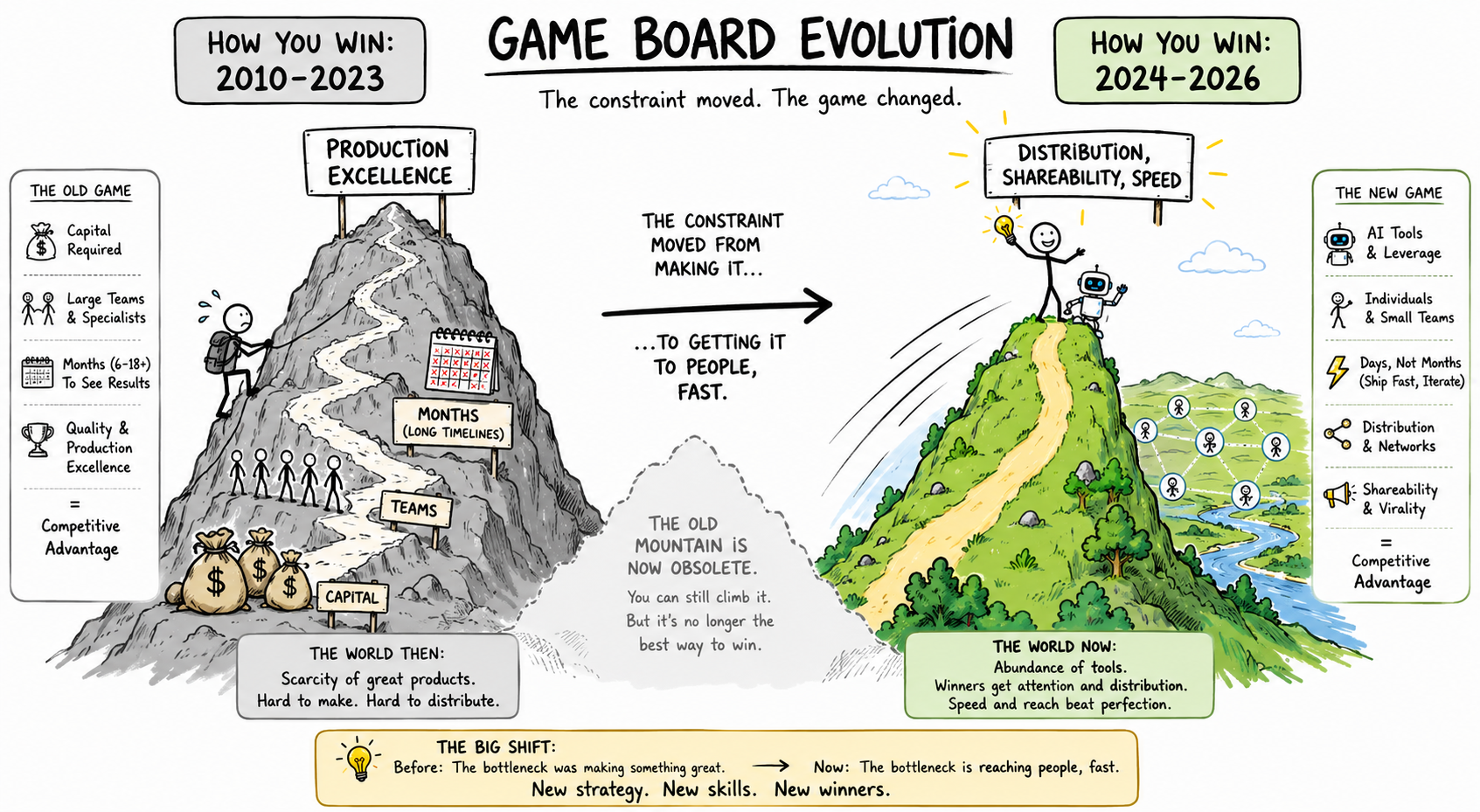
The old moat was production.
If you could build well, if you had great engineers, if you could ship quality products, you won. Distribution was secondary. You could make a really nice product and get picked up by an app store or a publisher. You could rely on quality to eventually find an audience.
That world is dead.
The new moat is distribution.
Because production is now effectively free. Claude Code, Cursor, v0, Bolt — pick your tool. You can build something in hours that would have taken months. You can ship something polished in days. You can iterate in real-time based on feedback. The hard part became easy.
And when the hard part becomes easy, everyone can do it. Which means quality doesn’t differentiate you anymore. What differentiates you is whether people know about your product and whether they want to share it.
Here’s the shift in one frame:
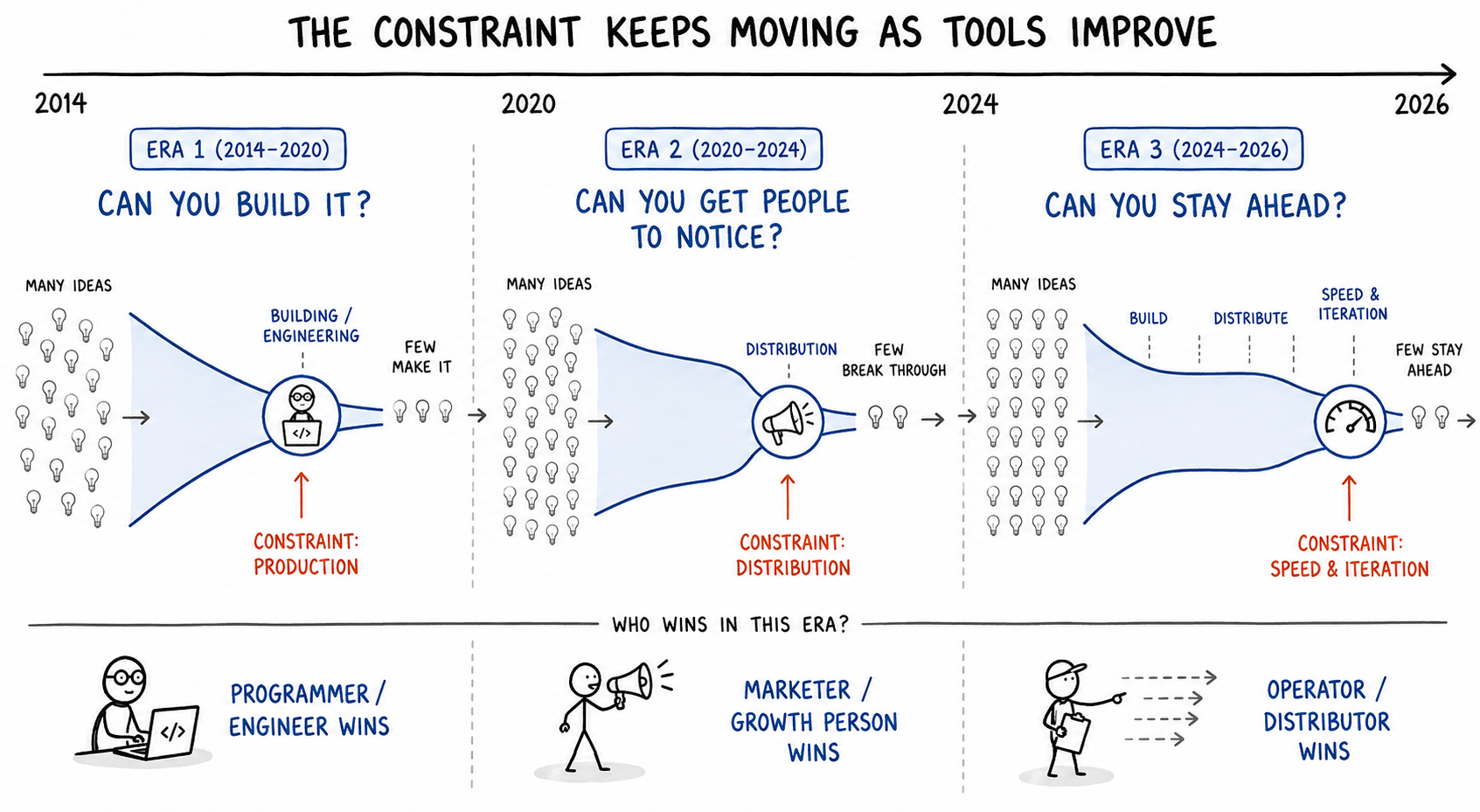
- 2014-2020: Can you build it? If yes, you win.
- 2020-2024: Can you build it? (Assumed yes.) Can you get people to download it? If yes, you win.
- 2024-2026: Can you build it? (Assumed yes, AI tools.) Can you distribute it? (Assumed you’re competing with everyone.) Can you make it worth sharing (ie. taste)? If yes, you win.
The constraint moved…
Three times in a decade. And it’s still moving.
Right now, distribution is the constraint.
Getting people to know. Getting people to care. Getting people to love it.
That’s where the advantage is.
But that will change too.
The moment distribution tools improve.
The moment sharing becomes even easier.
The moment AI makes it easier to unlock true taste… The constraint moves again.
The only constant is: whatever is hard and scarce is where the moat lives.
And right now?
That’s distribution & taste.