

ChatGPT passed 900 million weekly active users in February 2026. That’s according to OpenAI. You can dig into more of the numbers in our ChatGPT research.
When I first wrote this post in 2024, the conversation was simple. Use ChatGPT to write faster.
That conversation is over.
Heading into 2027, ChatGPT does two jobs for marketers. It’s a teammate that can research, draft, analyze and run multi-step tasks for you. And it’s a discovery channel where your buyers ask for recommendations before they ever hit your website.
If you only use it for the first job, you’re missing half the game.
In this article, I’m going to show you how to use ChatGPT for digital marketing in 2027. Both sides. The workflows that save your team hours. And the strategy that gets your brand into the answers. For those of you who love video…
Here’s a walkthrough of some proprietary research and the findings:
What Is ChatGPT In 2027?
ChatGPT is OpenAI’s AI assistant. In 2024 most people treated it like a smarter text box. Today it’s a lot more than that.
It searches the web in real time and cites sources. It remembers context about you and your work. It connects to the apps your team already uses. It can run agent tasks that click, browse and complete work across multiple steps. And as of 2026, it carries ads.
That last point matters. When a platform sells ads, it’s telling you something. People are making buying decisions there.
5 Shifts That Changed ChatGPT Marketing Since 2024
Here’s what’s different now:
- Search moved into the chat. Buyers ask ChatGPT for the best tools, agencies and products in their category. They get a short list. Often with citations. Sometimes without a single click to your site.
- Prompts gave way to context. The best results no longer come from clever one-line prompts. They come from feeding the model your brand voice, your audience, your data and your examples.
- Chat gave way to agents. ChatGPT can now carry out tasks, like researching 20 competitors or building a spreadsheet, while you work on something else.
- Memory became a marketing asset. The model remembers you. It also forms a picture of your brand from everything written about you across the web.
- Paid showed up. OpenAI launched ChatGPT ads in 2026 and opened a self-serve Ads Manager in the US. A new paid channel is forming in real time.
Let’s break down how to play each side.
Part 1: Use ChatGPT To Do The Work
Set Up A Project With Your Brand Context First
This is the step most teams skip. Then they wonder why every output sounds the same.
Before you ask ChatGPT for anything, create a Project or a custom GPT and load it with context. Your brand voice guide. Your ICP. Your positioning. Three to five of your best-performing pieces of content. Your product docs.
Now every prompt starts from your world instead of the internet’s average. The difference in output quality is massive.
Generating Content Ideas
Finding fresh ideas is still one of the best uses of ChatGPT. If you understand prompt engineering, it becomes a goldmine. Here are four prompts that still work extremely well:
1. Brainwriting
Prompt: “Let’s collaborate on generating ideas for [topic]. Begin by jotting down a multitude of ideas, and I’ll expand on them with relevant insights. Please format your response using markdown.”
2. Reverse Brainstorming
Prompt: “Use reverse brainstorming for [topic]. Generate deliberately poor ideas first, then flip each one into a fresh angle we could actually use.”
3. Mind Mapping
Prompt: “Create a comprehensive mind map for [topic]. Start with the core idea, branch into subtopics, then list the questions our audience asks at each branch.”
4. Assumption Reversal
Prompt: “List the common assumptions people in [industry] hold about [topic]. Challenge each one. Then identify 10 content ideas we could write based on the assumptions that don’t hold up.”
Here’s the 2027 upgrade. Turn on search and ask ChatGPT what questions people are asking about your topic on Reddit, YouTube and in forums right now. Ideas grounded in real conversations beat ideas pulled from thin air.
And remember the bigger picture. In our AI + Marketing study, 75% of marketers said content writers are most at risk due to AI:

My take… the writers at risk are the ones producing commodity content. Writers who bring original research, real experience and a point of view are more valuable than ever. Use ChatGPT to speed up the process. Keep the thinking human.
Creating Content Briefs And Outlines
Once you have the idea, ChatGPT can build a detailed outline with H2s, H3s and the key points for each section.
Go further. Ask it to search the top-ranking pages and the answers ChatGPT itself gives for your target question. Then ask: “What’s missing from all of these? What would a reader still need to know?” That gap is your angle.
Purpose-built tools like Frase and Jasper are still useful here if your team wants briefs built around search intent at scale.
Writing And Editing
ChatGPT can produce a first draft in seconds. It can also proofread, tighten your writing and adjust tone.
Use it for that. But don’t publish raw output. AI-generated sameness is everywhere now and readers can feel it. So can the models deciding what to cite.
My workflow: a human brings the insight and the outline. ChatGPT drafts sections. A human edits for voice, adds examples and cuts the fluff. Then ChatGPT does a final pass for clarity and errors.
SEO, AEO And GEO Research
Keyword And Prompt Research
ChatGPT is great for generating a starting list of keywords. It’s still not a keyword research tool. It can’t give you real search volume.
My recommendation hasn’t changed. Generate the list in ChatGPT. Then upload it into Ahrefs, Semrush, Moz or Similarweb for the real numbers.
What’s new is prompt research. Ask ChatGPT: “List 25 questions a [persona] might ask an AI assistant when evaluating [category].” Those are the prompts you want your brand to show up for.
On-Site Content Optimization
Paste in an existing page and ask ChatGPT to find outdated stats, thin sections and questions the page doesn’t answer. Ask it to rewrite your intro so the direct answer comes first. Clear, structured answers are easier for both search engines and AI models to pull from.
Exactly what I’m doing to this post.
Title Tags And Meta Descriptions
ChatGPT is still excellent at this. Try: “Write 5 title tags under 60 characters and 3 meta descriptions under 155 characters for an article about [topic]. Lead with the primary keyword.”
Digital Marketing Strategy
AI can change how you understand and map out the customer journey.
As an example, here’s a journey map ChatGPT created for someone buying a protein bar:
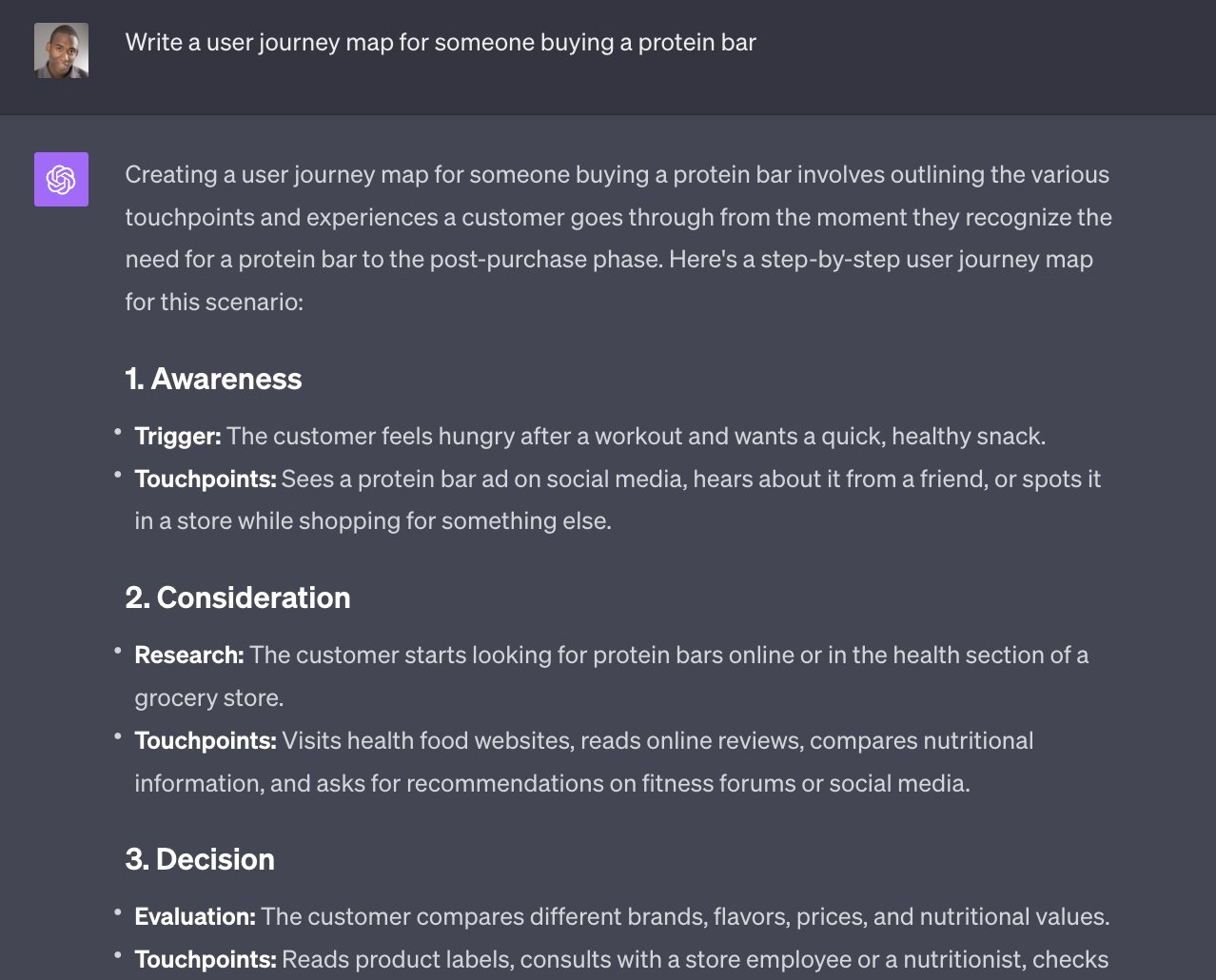
I’m not saying this journey map is fresh out of the mouth of the CMO at Pure Protein. But it’s pretty good. It’s on par with what most marketers with 3 to 4 years of experience could deliver.
The way to make it better is context. Give the AI exemplars, customer interview notes and real data, and the output improves dramatically. Here’s a sample of a prompt with more context and exemplars, which leads to better outputs:
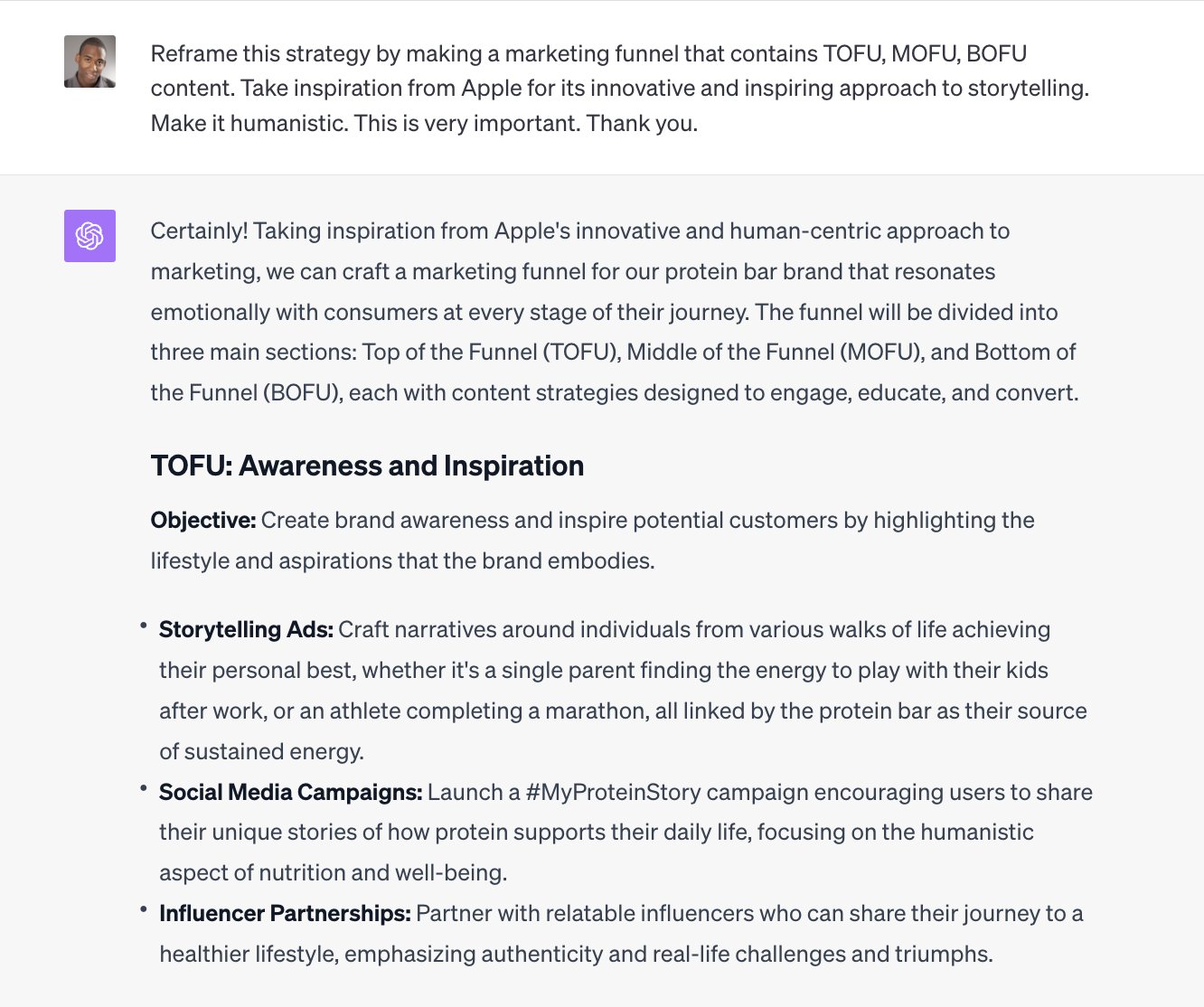
In 2027 you can push this further with agent mode. Ask ChatGPT to research your top competitors, pull their positioning, pricing pages and review site feedback, and compile it all into a single table. Work that used to take an analyst two days now takes an afternoon of review.
Social Media Marketing
Creating Engaging Posts
ChatGPT can draft posts for LinkedIn, Instagram, X, TikTok, Threads and Reddit. Load your Project with your top-performing posts first so it learns what works for your audience.
The bigger opportunity is distribution. I’ve said it for years… create once, distribute forever. Feed ChatGPT one blog post, webinar or podcast transcript and ask it to turn it into a LinkedIn carousel, a short-form video script, a Reddit post and a newsletter section. One asset. Many channels.
A few tools worth considering for social workflows:
- Jasper AI: Create on-brand assets for LinkedIn, X and more.
- Buffer: One of the original scheduling tools, with AI writing built in.
- Distribution.ai: Turn one piece of content into posts built for each channel. Full disclosure, this is my company.
Developing Video Scripts
Video is everywhere. Writing scripts still takes time.
ChatGPT can draft hooks, outlines and full scripts for YouTube, TikTok, Reels and Shorts. Ask for 10 hook options for every script. Pick the best one. Test it.
Here’s a video that shows how you can use Keywords Everywhere and ChatGPT to craft great TikTok scripts:
Email Marketing
Email remains one of the most effective channels for reaching your audience directly.
Drafting Email Campaigns
ChatGPT can draft newsletters, launch emails, nurture sequences and subject line variations. Prompt it with: “Draft a 4-email sequence for [audience] announcing [event]. Each email should have one clear CTA.”
Personalizing Email Content
Personalization still wins. Ask ChatGPT to write versions of the same email for different segments, like new trials, lapsed customers and power users. Or: “Write a follow-up email for customers who abandoned their cart.”
One more thing. Your newsletter archive is content too. Publish it on the web and it becomes something AI models can find and cite.
Data Analysis And Insights
Analyzing Marketing Data
This is one of the most underrated uses of ChatGPT. Upload a CSV export from Google Analytics, your ad platform or your CRM and ask for trends, anomalies and recommendations. It can write and run the analysis and build charts for you.
Always sanity check the numbers. But the speed is hard to beat.
Generating Reports
Ask it to turn raw data into a report your stakeholders will read. One of my favorite prompts: “Pretend you’re a McKinsey & Co analyst who has deep understanding in [topic]. Review the research and data attached and develop a report.”
Part 2: Get Your Brand Into ChatGPT’s Answers
This is the part most marketers still aren’t ready for.
Your buyers are asking ChatGPT questions like “What’s the best CRM for a 20-person sales team?” or “Which agencies are great at B2B content?” The answer they get is a short list. If you’re missing from that list, you’re invisible at the exact moment someone is ready to buy.
I call the goal Share of Model. How often does AI recommend your brand compared to your competitors?
Here’s how I think about earning it. Three layers:
- The SEO, GEO and AEO layer. ChatGPT’s search pulls from the web. Pages that rank, answer questions clearly and are technically sound get pulled into answers more often. Classic SEO still matters. It’s the foundation for everything else.
- The distribution layer. AI models cite sources beyond your website. Reddit threads. YouTube videos. Review sites. Industry publications. LinkedIn. Podcasts. If your brand only lives on your own domain, the models have very little to go on. Distribute your ideas everywhere your audience spends time.
- The memory layer. Over time, models build a picture of who you are and what you’re known for. Consistent positioning, repeated across many trusted sources, shapes what AI remembers about your brand.
Start simple. Make a list of the 20 to 50 prompts your buyers are likely asking. Run them in ChatGPT every month. Track where you show up, where competitors show up and which sources get cited. Then go earn a presence on those sources.
Part 3: ChatGPT Ads
OpenAI started testing ads in ChatGPT in early 2026. Sponsored placements appear below answers. Self-serve Ads Manager opened in the US in May 2026 and expanded to the UK in June.
It’s early. Inventory, targeting and measurement are still evolving. But early movers on new ad platforms usually get cheaper attention before the auction gets crowded.
My advice: carve out a small test budget. Pair it with your organic Share of Model work. Paid gets you on the page today. Organic keeps you there.
The 7-Step ChatGPT Marketing Playbook For 2027
- Build a ChatGPT Project with your brand voice, ICP, positioning and best content.
- Use it to generate ideas grounded in real audience conversations.
- Draft with AI. Edit, add insight and publish with humans.
- Repurpose every core asset across every channel your audience uses.
- Use agents and data uploads for research, competitor analysis and reporting.
- Track your Share of Model across the prompts your buyers ask.
- Test ChatGPT ads with a small budget and learn before your competitors do.
Limitations And Best Practices
Understanding Limitations
ChatGPT is far better than it was in 2024. It still makes mistakes. It can state wrong facts with total confidence. It can misread data. It lacks the lived experience of your customers.
Ensuring Accuracy And Originality
Fact check every stat. Click every citation. Add your own data, stories and examples. Original insight is what gets shared by people and cited by AI.
Privacy And Ethical Considerations
Don’t paste sensitive customer data into tools your company hasn’t approved. Use team or enterprise plans with the right data controls. Be transparent about how you use AI. And keep a human accountable for everything that goes out the door.
Final Thoughts
In 2024 the question was whether marketers should use ChatGPT…
In 2027 the questions are harder.
How much of your workflow runs through it? And when your buyers ask it for a recommendation, does your name come up?
Use it to work faster. Build your brand so it shows up in the answers. The marketers who do both will win the next decade.