

Is AirOps Worth It After 16 Months?
Yes, if you run real content volume and someone on your team owns the setup. No, if you expect results in week two.
Foundation has paid for AirOps since June 2025. We run content briefs, page refresh plans, and AI visibility tracking through it for a handful of client brands. Our research team also used its citation data to analyze 5.1 million AI responses and 57.2 million citations across 50 B2B brands. Sixteen months in, the scorecard is split.
In February 2026 our AI operations lead wrote the line that still frames how I think about it. In its configuration at the time, AirOps did not create measurable efficiency. The tool was capable. The gap was workflow architecture. Eight months later the team reports real progress on brief quality, especially outlines and audience fit. We still hand-edit wordiness. We still blow through task limits.
Our internal target was taking a content brief from roughly 4.5 hours of human touch time to 20 to 30 minutes of editor QA. We sit between those two numbers today. That is a win. It is still well short of the 10x the demo implies.
AirOps is the growth platform for search and AEO built around a simple idea. Unify the data that shows how a brand performs across AI and traditional search. Then let teams act on it directly, inside the same workspace, without routing everything through a separate agency or a six-week research phase. Analytics, citation tracking, and content operations sit in one place. A Brand Kit acts as the structured source of truth for voice, tone, products, and audiences, and every workflow draws from it.
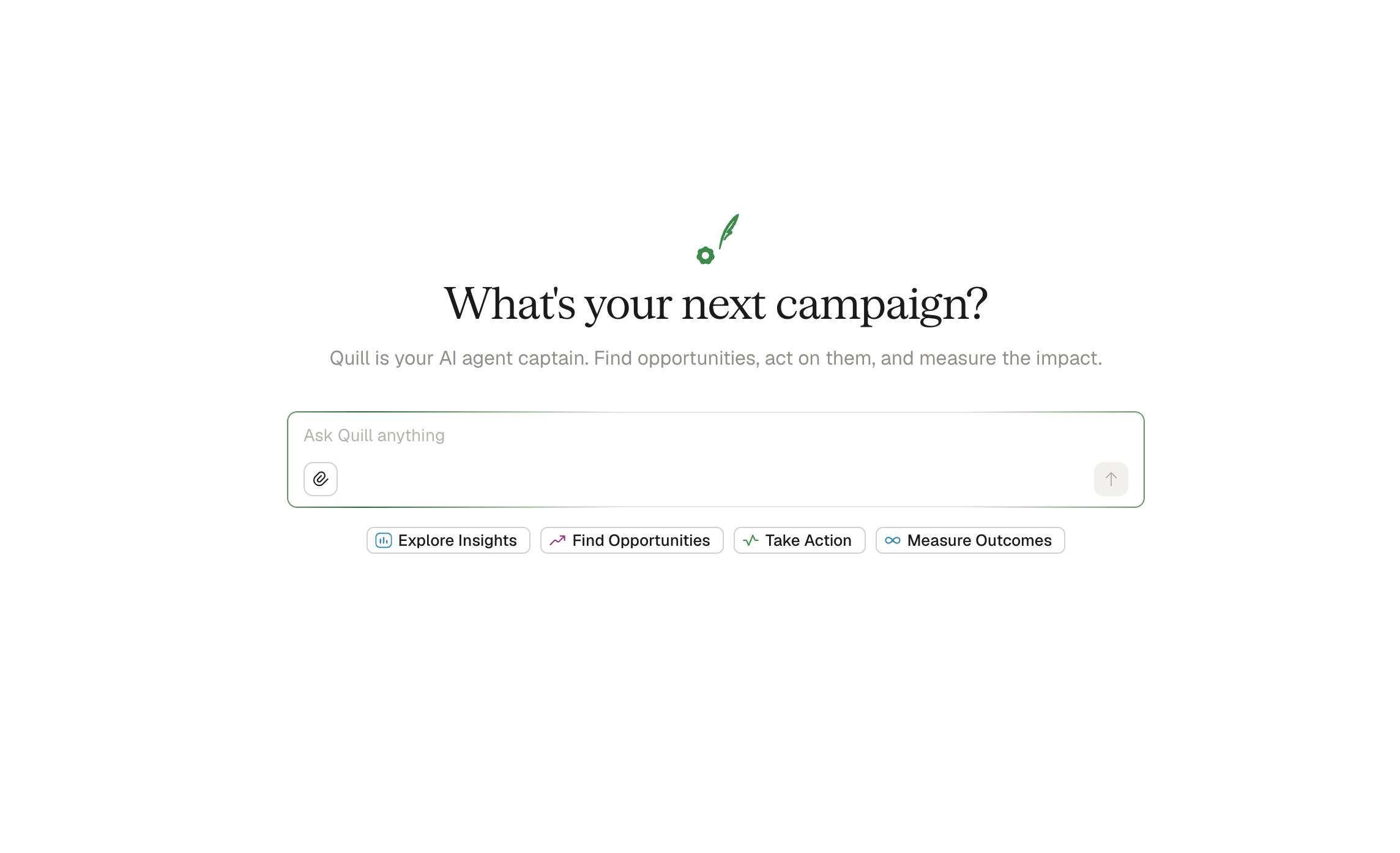
The newest layer on top of that foundation is Quill. Quill is an agent designed to move a team from insight to action without the manual back-and-forth of switching between tabs and dashboards. This review puts Quill through a real enterprise scenario to see whether that promise holds up.
Disclosure. Foundation has worked with AirOps citation data on our AI visibility research. I have also partnered with Profound, one of the tools AirOps competes with, on a webinar. I use both. Nobody paid for this review and nobody at AirOps saw it before it went live.
The Verdict In Sixty Seconds
AirOps is worth it if you have a large content library, an established strategy, and a team that will actually invest the setup time. It compresses the distance between spotting an AI visibility gap and having an on-brand draft in front of you from weeks to hours. It is expensive, the learning curve is real, and the AI visibility analytics are shallower than dedicated monitoring tools. Small teams without defined workflows will struggle to justify it. Enterprise brands, B2B SaaS companies, and agencies with real content surface area should take a hard look.
| What AirOps does well | Where it falls short |
|---|---|
| Quill turns a visibility gap into a prioritized plan and a draft in one session | Weeks of setup before the system feels logical |
| Brand Kit keeps output sounding like the brand, not like a model | Pricing is opaque and task-based credits are hard to forecast |
| Grids run one workflow across hundreds of URLs at once | Grids slow down past a couple hundred rows with multiple AI columns |
| Direct publishing to WordPress, Webflow, Contentful, Sanity | Best integrations are gated to higher plans |
| Refresh and rebuild content at scale | AI visibility insights are surface-level next to purpose-built monitoring tools |
| Human review steps are built into the workflow | LLM and regional coverage are limited below Enterprise |
The Category: Agents, Not Dashboards
Quill sits inside a category I would describe as “AI agents for AI visibility.”
The B2B world has spent years buying tools that report problems. Rankings are down. Share of voice is weak. Competitors own the key queries. AI answer engines cite everyone else. Useful data. Revenue does not come from dashboards.
Where most tools hand back a report, an agentic tool takes that data and acts on it, closer to how an in-house strategist would operate. Quill’s pitch is removing the manual grind of clicking through tabs by coordinating the work itself. Think of it as a captain over a set of AI agents under the hood. It studies your brand, reviews your site, spots content gaps, and recommends specific campaigns tied to organic growth and AI citation potential.
For a B2B SaaS team, this matters because speed matters. A recommendation that takes three weeks to brief, approve, and draft usually dies in the backlog. The next wave of content operations belongs to teams that connect research, strategy, drafting, and distribution in one workflow. That is the real shift, and it is bigger than any single platform.
Everything Starts With The Brand Kit
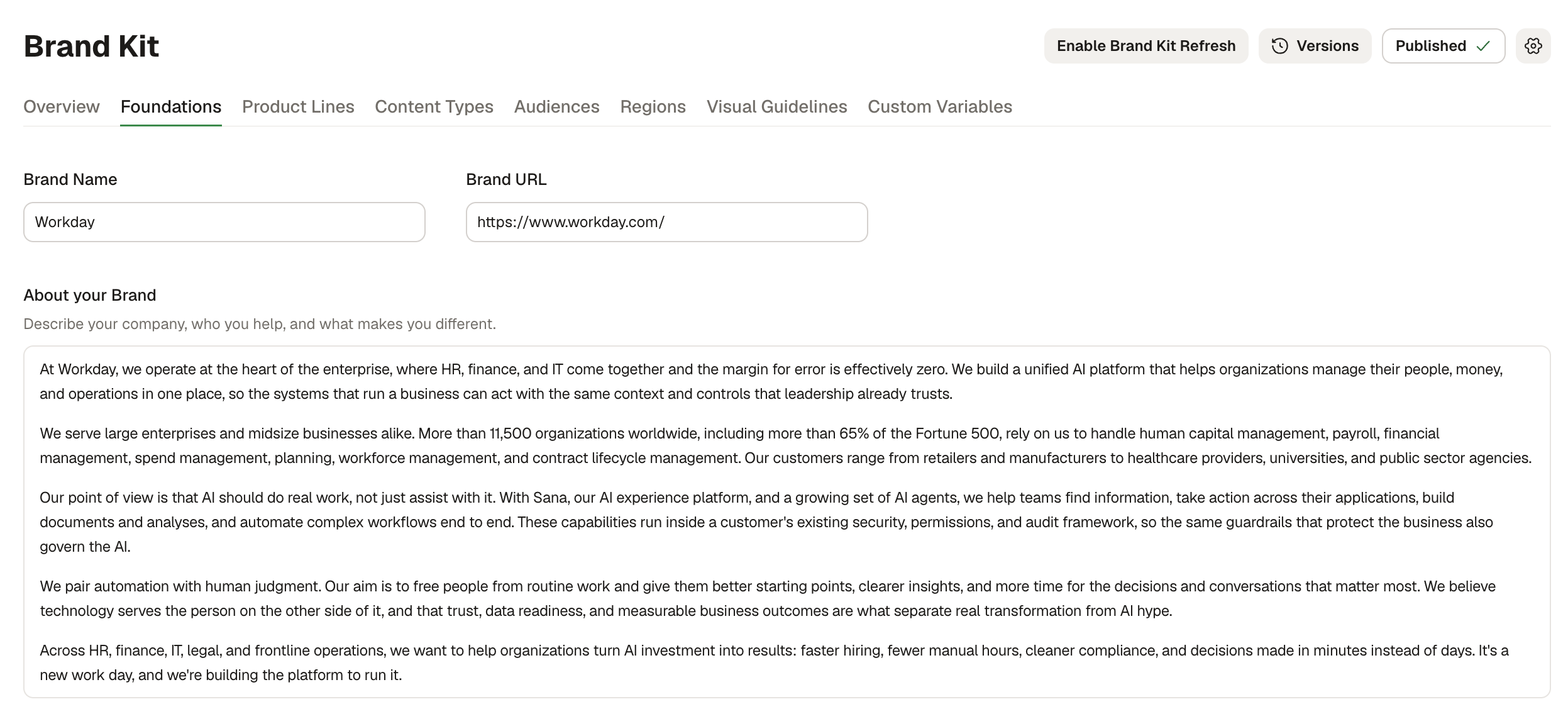
Before Quill can do anything useful, it needs the Brand Kit filled in.
That step sounds administrative. It is foundational. Positioning, tone, proof points, product details, competitive context, audience definitions. Output quality depends entirely on how thoroughly it is done. Half-fill it, and the result is half an answer.
This is a good reminder for marketing leaders. AI does not remove the need for strategic clarity. It raises the penalty for sloppy inputs. A well-built Brand Kit produces content that sounds aligned with the company. A vague one produces the generic SEO copy everyone is already drowning in.
The test ran on a Workday-based Brand Kit to see how Quill performs in a genuine enterprise context.
The Test: One Question, Six Prioritized Actions
I asked Quill for a bottom-of-funnel strategy to drive organic traffic and AI visibility for Workday. That is the kind of question that historically took agencies weeks and a lot of billable hours.
Quill did the research before it made a recommendation. It read several layers at once:
- The Brand Kit
- Existing site pages and page inventory
- Topic coverage
- AEO citation domains
- Search engine results
- Funnel-stage gaps
Then it returned six concrete actions in plain language, prioritized.
The diagnosis was sharp. Workday has 35 product pages, and all of them are written as sales-oriented marketing copy. LLMs favor neutral, definitional content when they decide what to cite. In Previsible’s study of 5,000 prompts, 58% of pages cited for informational queries followed a definition, context, example structure, and pure conversion landing pages rarely got cited at all. That mismatch is a clear opportunity, and it is exactly the kind of specific, actionable, discoverability-tied insight content teams need more of.
Similar work used to take days, sometimes weeks. Quill compressed it into a single session.
From Insight To Draft
The biggest win is operational.
A single question produced multiple plays laid out in a grid: briefs, research, drafted articles, and one-click workflows for internal and external links. Drafts pull directly from the Brand Kit’s positioning, tone, and proof points, so the output actually sounds like the brand.
Content velocity usually breaks between planning and execution. A stronger system looks like this:
- Identify citation and query gaps
- Prioritize the pages with business value
- Draft on-brand assets quickly
- Run editorial review
- Publish and distribute
This is the distribution-first view of AI. The goal is to reduce friction between insight and execution so strong ideas travel faster. Flooding the site with machine-written pages is a different goal, and a bad one.
The Rest Of The Platform
Quill is the headline. It sits on top of a platform that has been maturing for a few years, and you will spend real time in these parts too.
- Workflows and Power Agents: A drag-and-drop builder where you wire together steps like research, outline, draft, fact-check, review. Powerful. Also the source of most of the learning curve. Expect it to take longer than you think.
- Grids: Spreadsheet-style execution. Point a workflow at hundreds of URLs and let it run. My favorite part of the platform for refresh work. Expect lag on very large grids.
- Insights: Share of voice, citation share, citing URLs, competitor benchmarks, basic sentiment. Enough to start. Thin if AI visibility analytics are your primary reason to buy.
- Opportunities: Prompt gaps, declining citations, weak content, sorted into buckets you can push into a Grid. Some recommendations come with a workflow attached. Others, like mention gaps that require outreach, leave you to figure out the next step.
- Pages and Smart Filters: A content inventory with filters like Almost Page One, Losing Clicks, Rankings Slipping, Declining Citations. Genuinely useful for large libraries.
- Integrations: WordPress, Webflow, Contentful, Sanity, Ahrefs, Semrush, Moz, DataForSEO, Google Search Console, GA4, HubSpot, Notion, and multiple LLMs. Many are gated above the entry plans.
The Technical Side: API, MCP, And What The Docs Get Right
AirOps is more programmable than most marketing teams will ever need, and that is a point in its favour for agencies. Three layers matter.
- The Insights API. Everything on the AI visibility dashboard is available over REST under a Brand Kit resource. The analytics endpoint takes any mix of nine metrics (mention rate, share of voice, citation rate, citation share, sentiment, average position, first-mention rate, and counts) across up to three dimensions (date, provider, topic, country, persona, competitor, domain category). Grain caps are 120 days daily, 180 weekly, 365 monthly, with 1,000 rows per query. A Web Pages endpoint joins citation data with Search Console and GA4 per URL and ships smart filters like losing_ai_visibility and almost_page_one. Free workspaces get a 402 on that one. There is a Looker Studio connector if you would rather not write code.
- Workflow execution. Any Workflow runs via API endpoint, incoming webhook, Zapier, or schedule, and the Knowledge Base has its own API for writing documents in. This is how we push outputs into ClickUp and Google Docs instead of living in the interface.
- MCP. AirOps exposes Brand Kits, Insights data, Grids, and Knowledge Bases to Claude, Cursor, and Codex through an MCP server, and the reverse direction lets a Playbook call external MCP servers. Our ops lead’s original Brand Kit refresh design routed through an MCP between Claude and AirOps. In 2026 that is a fully supported path.
The docs themselves deserve a line. Every page is available as markdown by appending .md to the URL, there is an llms.txt index, and the site answers questions over a GET request. For a company selling AI discoverability, that is practicing what it preaches. It also made researching this review faster than any vendor site I have used this year.
Where the technical experience strains:
- Task accounting is opaque until you read the billing docs. Some steps count, some do not, a Claude answer counts four times, and nothing in the builder tells you the task cost of a run before you press go.
- Formatting edge cases eat hours. Getting an outline into a table inside a table took our first solutions architect a long session with a reasoning model to get the code right. Plain markdown output is the safer default.
- Prompt management was rigid for a stretch. In May 2026 you could add tracked prompts but not edit them, which matters when every prompt costs credits. Check the current state before you scale a client’s prompt set.
- Grids slow down past a couple of hundred rows with multiple AI columns. Chunk large refresh jobs.
Security is SOC 2 Type II. The docs name OpenAI, Anthropic, and Google as model providers, but only spell out retention terms for OpenAI, including zero data retention on Enterprise. You can also bring your own OpenAI, Anthropic, and Gemini keys.
Where The Product Draws The Line
I give Quill a lot of credit. It is still worth being clear about the edges.
- The Brand Kit has to be genuinely good. Weak input produces weak output. There is no shortcut here.
- Human review is still non-negotiable. Publishing hundreds of AI-drafted pages without an editorial pass is a bad idea. Quill gets teams to roughly 80% done. The last mile still needs people. I would review the output, refine the messaging, add rich media, and align every page with brand standards before it goes live.
- The learning curve is real. Weeks, not days, before the workflow builder feels natural. AirOps has an academy, cohorts, and an embedded copilot to help. Budget the time.
- The visibility data has limits. LLM coverage and regional data are narrower below the Enterprise tier. If deep AI monitoring is your primary need, pair it with a dedicated tool or look elsewhere.
The framing I keep coming back to: a citation gap to an 80%-complete, on-brand page set used to take weeks. Now it takes hours. The editorial layer does not disappear.
Who This Is Actually For
Not a local coffee shop.
This is built for enterprise brands, B2B SaaS companies, professional services firms, and agencies with the content complexity where a research-to-draft workflow moves the needle. If your business depends on visibility across Google, ChatGPT, Perplexity, Reddit, and other trust-driven channels, AI visibility is no longer a side project. It is part of your pipeline infrastructure.
Buy it if:
- You already know what good content looks like and want to produce it faster
- You have a large library that needs refreshing or a steady stream of new pieces
- You have someone who will own the setup and the Brand Kit
- You can tolerate a learning curve in exchange for compounding speed
Look elsewhere if:
- You publish fewer than ten pieces a month
- You still need to define your strategy and workflows
- Deep AI visibility monitoring across many models and regions is the main job
- Predictable, flat pricing matters more than execution depth
Frequently Asked Questions
What is AirOps used for? AirOps is used to plan, produce, refresh, and publish content at scale, with AI visibility and traditional search data feeding the decisions. Teams use it to build repeatable content workflows, run them across large sets of pages, keep output on-brand through a Brand Kit, and push finished work directly into a CMS.
Is AirOps good for AEO? Yes, with a caveat. AirOps is strong at turning AEO gaps into publish-ready content, which is the part most tools skip. Its monitoring layer is lighter than dedicated AI visibility platforms. If execution is your bottleneck, it is a strong fit. If measurement is your bottleneck, look at pairing it with something else.
Can I replace my SEO stack with AirOps? Partly. AirOps integrates with Ahrefs, Semrush, Moz, Search Console, and GA4 rather than replacing them, and its Insights module gives you a working view of search and AI performance. Most teams keep their core SEO tools and use AirOps as the execution layer on top.
Is AirOps trusted by enterprise SEO teams? AirOps lists customers like Webflow, Ramp, Carta, Chime, and Klaviyo, and its Enterprise tier is where the full LLM and regional coverage lives. It is built for the enterprise use case. The learning curve and setup investment make the most sense at that scale.
How is AirOps different from other AEO tools? Most AEO tools stop at analysis: citations, share of voice, prompt gaps. AirOps, and Quill specifically, takes the analysis and moves toward action, producing prioritized recommendations, briefs, and drafts inside the same workspace. It trades some analytical depth for execution depth.
What are the best AirOps alternatives? Profound, Scrunch, Athena, Petra Labs, Surfer, Semrush, and Ahrefs Brand Radar all show up in the conversation. Which one fits depends on whether you need monitoring, execution, or both. I am working on a full comparison.
The Takeaway
AirOps is positioning Quill as the shift from “here’s your data” to “here’s your data, diagnosis, and a drafted first move.”
Most teams already have expertise. They already have topics worth covering. They already have data. What they lack is a system that turns those inputs into citable, on-brand, revenue-relevant content fast enough to matter. Quill’s value is compressing the distance between spotting a content gap and having something publishable in front of you. Human judgment still decides what goes live.
Build the engine first. Then ship with precision.
Watch the full walkthrough: