

What unblockable looks like

Unblockable is easier to recognize than to define, so start with what it looks like.
Unblockable in a question. It’s 4:55 on a Friday. The campaign goes live Monday. The landing page is broken, the developer is on a plane, and the client just emailed asking where things stand. You get to pull one person off whatever they’re doing. Who do you grab? Picture the face. That person has something, and I call it unblockable.
Unblockable in three sentences. Optimism knocks on the locked door and waits. Pessimism walks away. Unblockable is already around the back trying the window.
Unblockable in a moment. 2008. Airbnb is out of money and no investor will touch it. The founders design two cereal boxes for the election, Obama O’s and Cap’n McCain’s, hot-glue a thousand of them by hand, and sell them for $40 each. About $30,000 later the company is still alive, and Paul Graham funds it on the strength of the cereal (Fortune).
Blockable in a moment…
A marketing team spends tens of thousands of dollars on a whitepaper that gets 47 views. Meanwhile, the top result for their category is a Reddit thread a stranger wrote in 2016. Nobody on the team has ever opened it.
How to spot unblockable people
I’ve spent twelve years hiring marketers. The resume rarely tells you. These do:
- They send a Loom instead of a question: The problem arrives half-solved, with their best guess attached. Low agency sends the question and waits.
- They’ve shipped something nobody asked for: A side project, a newsletter, a tool, a subreddit. Proof they can start from zero without a brief.
- They tested it on their own account first: Before they pitch Reddit to a client, they’ve posted there themselves and taken the downvotes: The pitch arrives with screenshots.
- They treat the algorithm like weather: Everyone else is furious about the update. They’ve already packed a jacket.
- Legal said no and the thing is still live: Rewritten, routed through a different owner, compliant… and live.
- They know their number before the meeting starts: Pipeline, traffic, cost per lead, whatever the room cares about. Agency starts with knowing exactly where you stand.
- They light up at “what would you do with zero budget.”: Most people hear a trap. Unblockable people hear a brief.
Put every person you’d grab at 4:55 on a Friday in one room…
What they share is simple. They act on the situation before the situation finishes acting on them. Age, title, and optimism have nothing to do with it. The difference shows up in how sentences like this lands:
| The sentence | Blockable hears | Unblockable hears |
|---|---|---|
| “There’s no budget.” | A verdict. | A constraint. What ships for $0? |
| “Legal said no.” | The end. | A draft. What exactly did legal object to? |
| “The algorithm changed.” | Sabotage. | Weather. Which channel do we lean on this quarter? |
| “Our buyers aren’t on Reddit.” | A fact. | A claim. Who checked, and when? |
| “We tried that in 2021.” | Case closed. | A data point from 2021. What’s different now? |
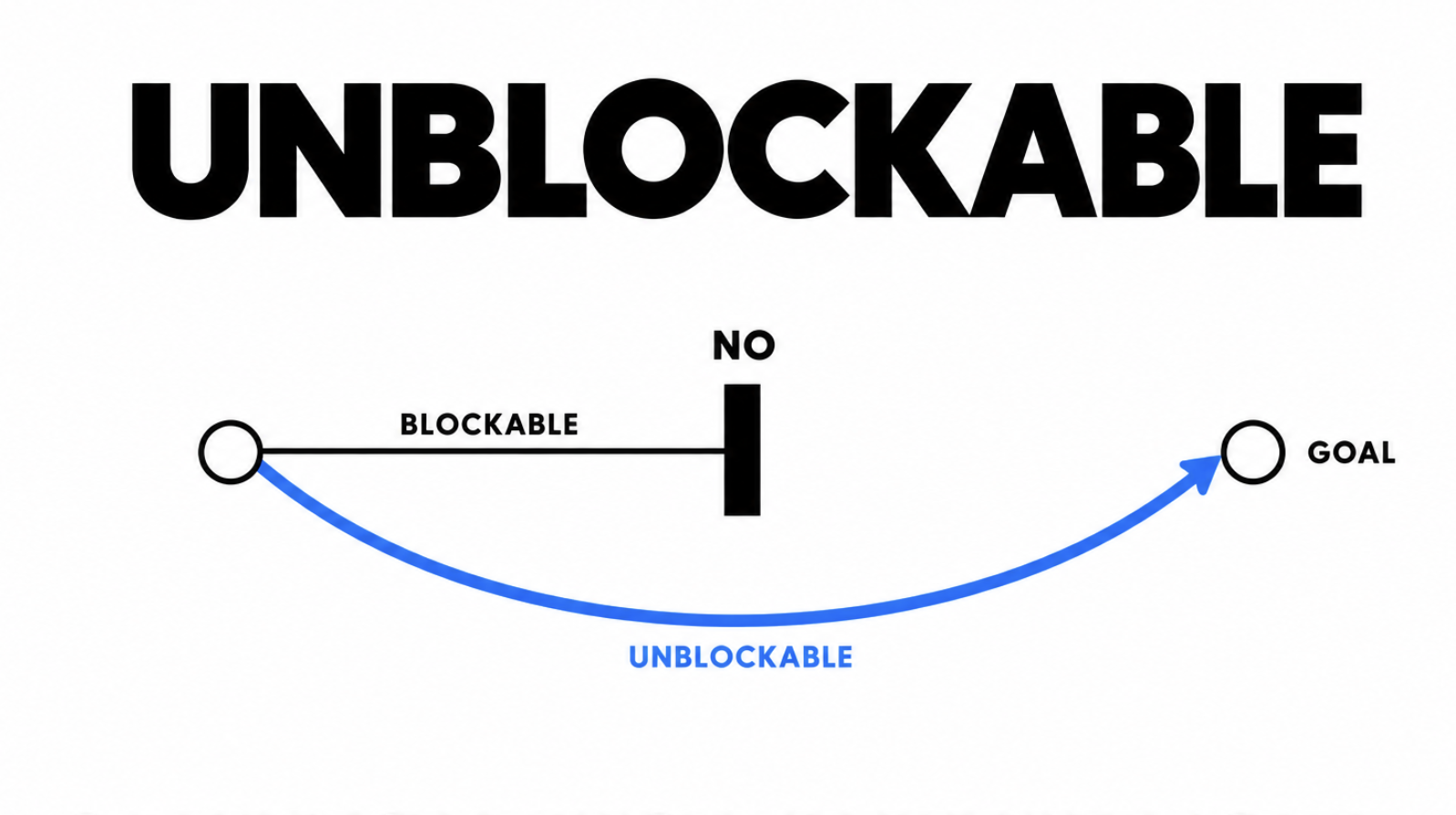
Blockable treats the sentence as a road closure and parks. Unblockable hears the same sentence and starts rerouting… the destination stays, the route changes. If you’ve ever watched a map app recalculate without arguing with the closed road, you’ve seen the trait.
Psychologists have had a word for the wiring underneath this since the 1960s: locus of control.
People with an internal locus believe outcomes mostly follow from their own actions.
People with an external locus believe outcomes mostly follow from luck, timing, and other people.
A 2006 meta-analysis in the Journal of Organizational Behavior found internal locus tied to better task experiences and higher motivation at work (Ng, Sorensen and Eby).
In plain English, the people who believe the route is theirs to change are the ones who change it…
In marketing, that wiring shows up as three habits. Water does all three to a wall, which is why water wins.
- They find the seam. Every no has a soft spot… a budget line that could move, a lawyer who objected to one sentence, a stakeholder nobody has actually asked. Unblockable people look for the seam before they look for the exit.
- They take the long way… If the front door is locked, the longer route still ends at the same place. A Reddit thread instead of a paid campaign. A founder’s LinkedIn instead of the brand account. Slower, cheaper, and it gets there.
- They keep coming… Water shows up every day until the rock is a different shape. The marketer who pitches the idea again next quarter with better data beats the one who pitched it once, beautifully.
Part 1: Five sentences unblockable people run on
Five sentences I had to learn the hard way, usually after getting blocked by the opposite belief.
1. No is a data point.
A no tells you where the path bends. It tells you nothing about whether the destination exists. When a client said no to Reddit in 2018, the no told me they’d never seen the data. So we went and got the data.
2. The algorithm is weather.
You can be angry at rain or you can pack a jacket. Every platform will change the rules on you, probably this year. The only durable answer is distribution across enough channels that no single update can block you. I literally wrote a book about it.
3. Nobody is coming to pick you.
There’s no committee somewhere deciding who gets to build. The agency founders you admire are figuring it out live. So are the CMOs. When I started Foundation in 2014 nobody handed me a playbook, and the gatekeepers I was afraid of turned out to be mostly busy.
4. Zero budget is a creative brief.
“We don’t have budget” is the most common no in marketing. It’s also the sentence behind every great Reddit thread, newsletter, and LinkedIn post you’ve read this year. The research agrees. A 2019 review of 145 studies in the Journal of Management found that constraints, scarce money and time included, tend to raise the motivation to innovate, and that abundant resources do the opposite by letting teams settle on the first familiar answer (Acar, Tarakci and van Knippenberg). The effect only breaks when the constraint becomes crushing. A frozen budget sits well inside the range.
5. The time to do was yesterday.
Speed is the advantage and it compounds. The marketer who posts the imperfect version today learns more by Friday than the one who schedules a review of the perfect version for next quarter.
Part 2: The most unblockable move in music
Brooklyn, 1995.
Shawn Carter is 25, from the Marcy projects, and the major labels have passed on him. For most artists that’s where the story ends. The no is a verdict.
He and two friends, Damon Dash and Kareem Burke, treated it as a road closure. Three nos stood between him and the album, and they rerouted around every one:
- No label would sign him. So they started one. Roc-A-Fella Records, 1995.
- No distribution. A label without it is a logo. They pressed the records, sold them out of the trunk of the car, and used those sales to land a distribution deal.
- No radio, no budget, no co-sign. They made the album so good the industry had to come to them. Reasonable Doubt dropped in 1996. Within a year Def Jam bought half the label. Less than a decade after that, the guy nobody would sign was running Def Jam.
That’s unblockable in action. He never waited for the story to improve… he wrote the next line. The play is available to anyone with a trunk and a reroute.
Part 3: Five blockable traps and the way out of each
Blockable has a texture. It looks like a marketer sitting on a great idea for three quarters because one person said one sentence. These are the five traps I see most, and the way out of each.
1. The Permission Trap
You’re waiting for the yes. From the CEO, from legal, from the budget cycle. Meanwhile the idea ages. The way out is to ship the version that needs no permission. A Google Doc. A LinkedIn post. A Reddit comment. A Loom to one customer. Permission follows proof far more often than it precedes it.
2. The Attribution Trap
“We can’t measure it, so we can’t do it.” This sentence has killed more Reddit programs than Reddit ever did. The way out is to run it as an experiment with a date and a number you pick in advance. Thirty days, twenty comments, one metric. A scientist with a hypothesis is a much easier person to be than a marketer waiting on a dashboard.
3. The Expert Trap
Someone with authority said it doesn’t work. An agency, a consultant, a VP who ran the test in 2021. The way out is to ask where the rule came from. What data, what year, what channel. Most rules in marketing are one person’s bad quarter repeated until it sounds like physics.
4. The Algorithm Trap
The update hit. Reach is down. The team spends the quarter mourning. The way out is to treat it like weather and pack accordingly… distribution across channels you own and channels you rent. The brands still standing after every update were the ones that never depended on one.
5. The Room Trap
This one lives inside you. “I don’t belong in this room.” It shows up as leaving before you’ve asked for the thing. I grew up in Preston, Nova Scotia, with no agency connections and no obvious path into this industry, and I still catch this one mid-sentence in boardrooms. The way out is to ask for the thing before you leave. Out loud. The room will survive it, and so will you.
Part 4: Run the reroute
Everything above is theory until you run it on a real no. This takes fifteen minutes, and it works best on the no that annoyed you most this week.
- Write the no down word for word. “There’s no budget for video this quarter.” Specific nos are solvable. Vague ones just sit there.
- Find the owner of the no. A budget no belongs to finance. A legal no belongs to one lawyer. A “we tried that” no belongs to one person’s memory. Nos have owners, and owners can be talked to.
- List ten ways around it. Cheap ones, weird ones, embarrassing ones… sell it from the trunk. Judge nothing until the list has ten things on it.
- Pick the one you can do before 5pm today. Small enough to start, big enough to count.
- Do it, then tell one person you did it. The telling is what makes it stick.
- Come back tomorrow with the next no.
Three tools for when you get stuck:
The trunk test. Imagine the platform you depend on disappears tomorrow and you have to sell this out of the trunk of your car. Whatever you’d do next is your real distribution strategy.
The zero-budget draft. Before you ask for money, write the plan that costs nothing. Half the time it’s the better plan. The other half, it’s the pitch that gets you the money.
The 4:55 test. Use it in hiring. Then use it on yourself, and think about whether anyone would grab you.
And the cost, because I’d be lying if I skipped it. The same wiring that refuses to accept a no at the office doesn’t switch off at dinner. I’ve carried it home to my kids. I’ve pushed past a teammate who turned out to be right. Disagreeability with no off switch turns into ego fast. You take this trade-off with your eyes open or it takes you.
People confuse unblockable with force. Force meets the block head-on and spends itself. Unblockable is agency with no fixed surface. Soft where softness routes around the obstacle. Hard where hardness is the only move left.
If you’re early in your career and you’re reading this, you have an advantage most people in this industry will never use. Nobody has told you what’s impossible yet. Find the sentence you’ve been treating as a verdict… the frozen budget, the no from legal, the room that already decided. Reroute. Write the next line.